In the art historical tradition, Mary of Magdalen is often depicted with an ointment jar. Besides being a visual representation of a recurring attribute, this jar is first and foremost an olfactory symbol, as she was one of the ‘Myrrh Bearers’ who visited Jesus after he deceased to anoint him with aromatic resins (‘myrrh’ is often used in the Bible to signify ‘resin’ and not a specific resin).
But she is often confused with the main character of another fragrant story; that of Mary of Bethany.
In this story from the New Testament Jesus is invited by Lazarus’ to celebrate his resurrection (since Lazarus had been dead for a while, the ancient text mentions that he smelled quite foul, but only to disbeleivers). When Jesus arrived, Mary ‘took a pound of pure and very expensive spikenard oil. She poured it over his feet, and wiped them dry with her hair. The whole house was filled with fragrant perfume’.
Although the meaning has gone lost, this sentence is incredibly significant.
First of all, a pound of spikenard – which would have come all the way from the Himalayas and which smells like valerian – would have cost a year’s income. This means this particular Mary must have been quite wealthy and generous, suggesting she was quite close to Jesus. Secondly, the use of spikenard was restricted to kings, pharaoh’s, priests and God. By applying this specific oil, she was giving off a clear message: ‘someone of divine status is among us’. This message was immediately understood by everyone since ‘the whole house was filled with fragrant perfume’.
Finally, evangelist John mentions how Mary anoints Jesus’ feet. Since this is customary for the deceased, and not the living, Mary was demonstrably aware of Jesus’ untimely death which was to happen in a week from then.
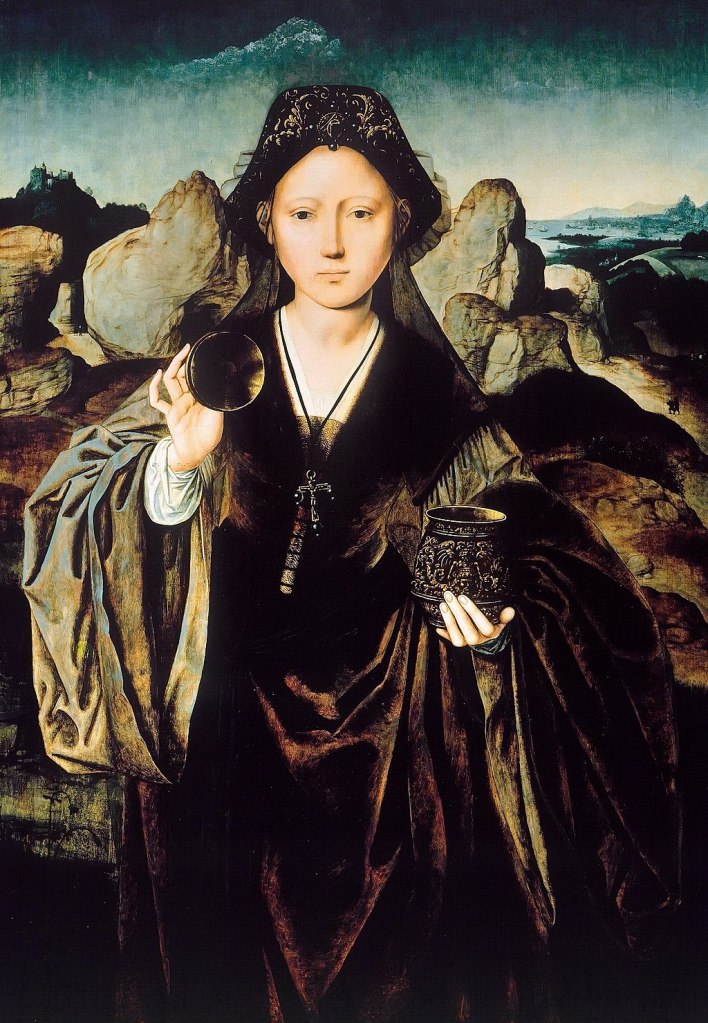
This specific composition by the Master of Mansi – a Dutch Renaissance painter – is extraordinary and quite rare. Mary is positioned at half-length, full faced, looking the viewer straight in the eyes and opening her jar, actively involving you in the action. It is almost as if she wants to enable you to connect to the story by putting yourself in Jesus’ position, and imagining the smell escaping her jar like a fragrant promise. And we are all nose witnesses.
Master of Mansi Magdalene (active 1510-1525), Mary of Magdalene, circa 1525, collection Gemaldegalerie
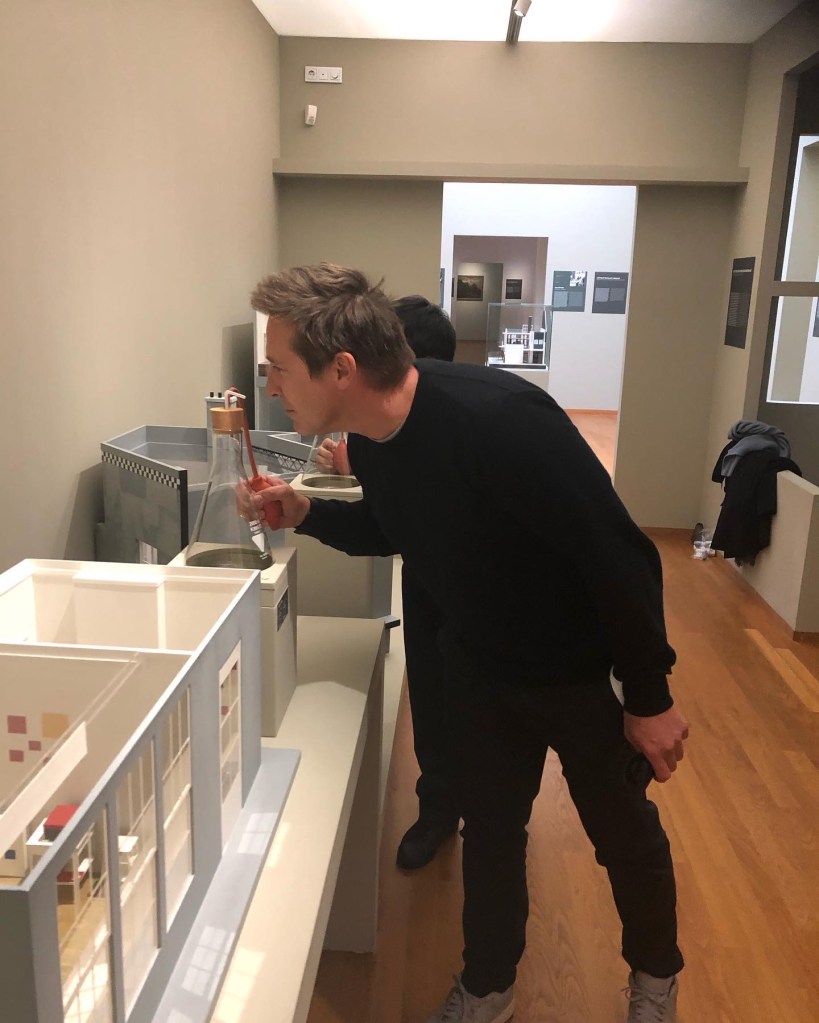
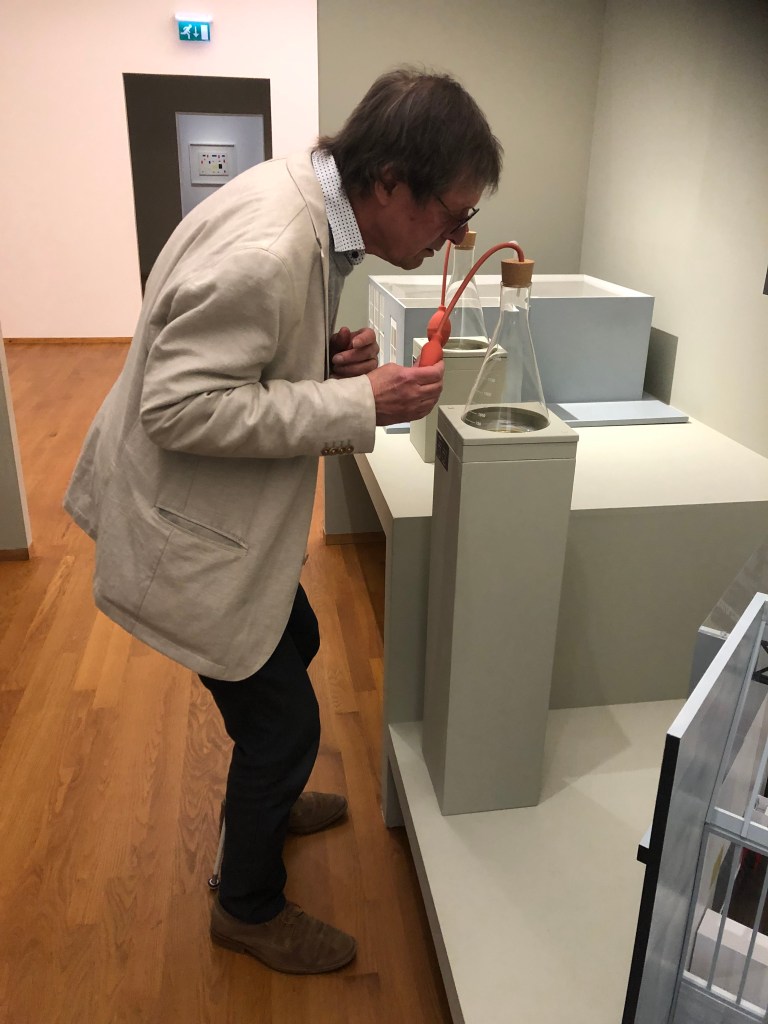
Bernardo Fleming from IFF examines the scent of Mondrian’s New York studio.
Technically, scents consist of a collection of molecules that penetrate our nostrils. Scents, elusive as they may seem, are a tangible reflection of materials, activities, events, and thus of eras and places. Yet, a scent is more than just its physical components; once odor molecules reach our noses, they unlock an immense, previously hidden mental space within us, composed of memories and emotions. A single scent can convey more than a thousand images, and a single whiff can transport us back to a distant past. Mondrian himself was sensitive to such stimuli, possibly due to his grandfather’s profession as a perfumer (and wigmaker). For example, in 1910, he wrote to his close friend Aletta de Iong:
I think flowers are such an extraordinarily wonderful thing. There were such masses on that square behind Boymans this week! The smell of it also makes me feel very strange.
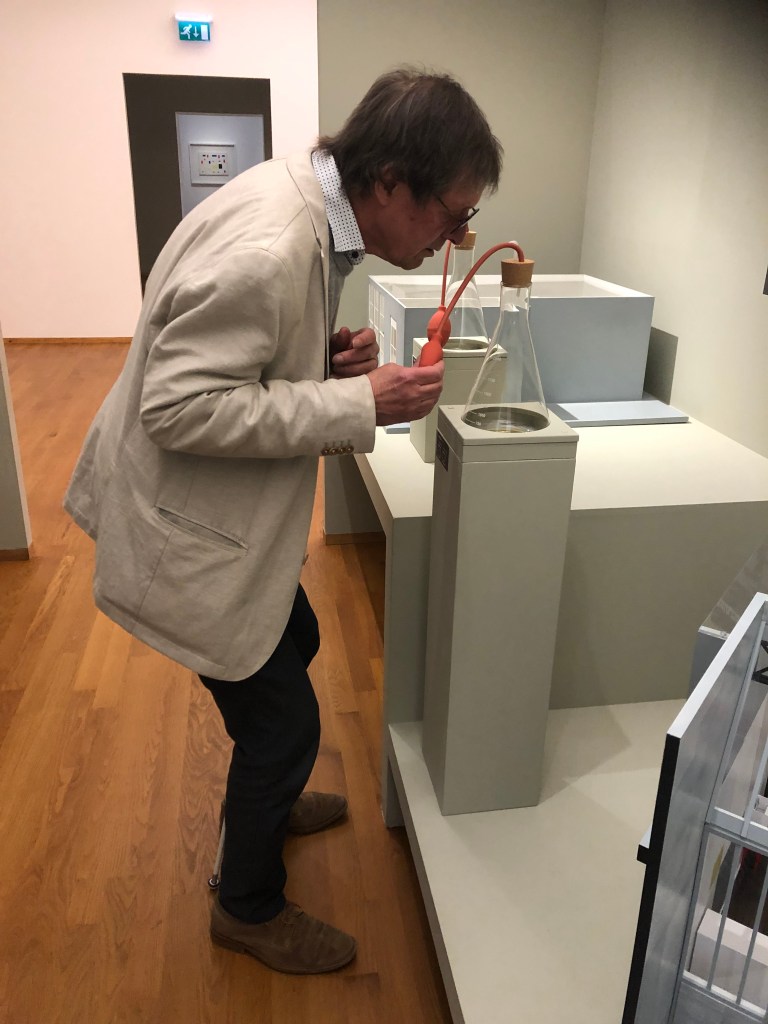
The photographer Hannes Wallrafen (who turned blind later in life) smells the scent of Mondrian’s Paris studio.
In Mondrian’s 150th birth anniversary year (2022), curator Caro Verbeek of the Kunstmuseum Den Haag wondered if it would be possible to reconstruct the scent of Mondrian’s living environments. This question led to even more intriguing inquiries: what might the bygone scents of Mondrian’s studios in Amsterdam, Paris, and New York reveal to us? How do they relate to the changing world in which the artist lived and created? Could we even, perhaps, smell his journey toward abstraction?
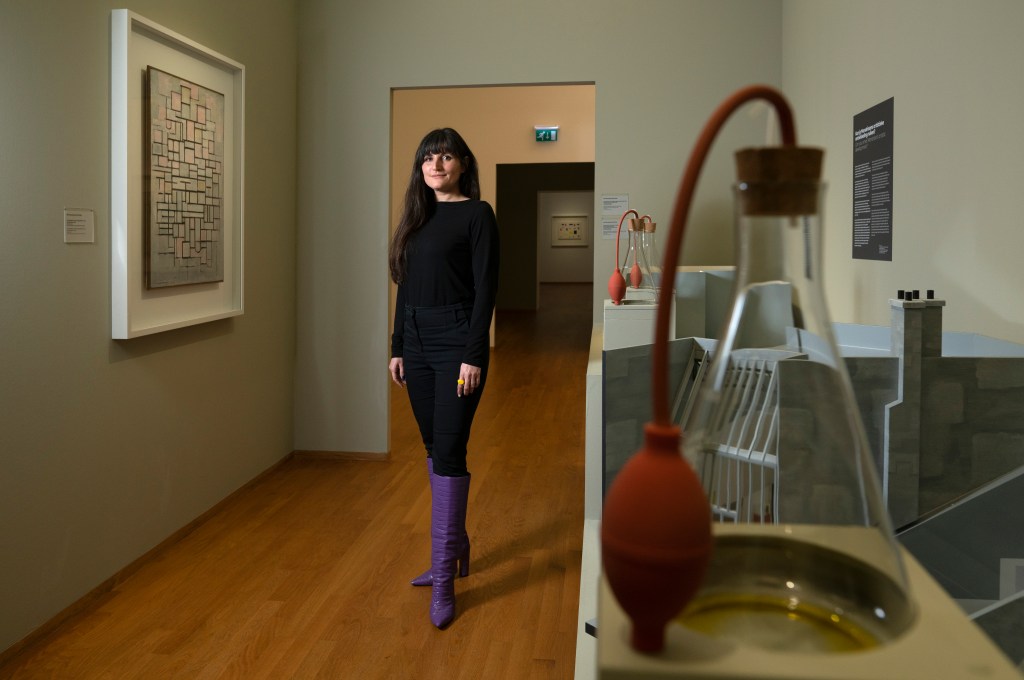
Thanks to a collaboration with IFF perfumers, visitors have been able to experience these scents themselves for several years through a permanent olfactory exhibit in the “Mondrian & De Stijl” section of the museum. Based on research by curator Verbeek, IFF perfumers Anh Ngo and Birgit Sijbrands, under the guidance of Bernardo Fleming, created a scentscape of three distinct fragrances. Visitors frequently report that the compositions make them feel as though they are standing alongside Mondrian in his studio, rather than merely observing his work. This has fostered a deeper empathy for him as a flesh-and-blood individual.
Colonial Aromas of Amsterdam
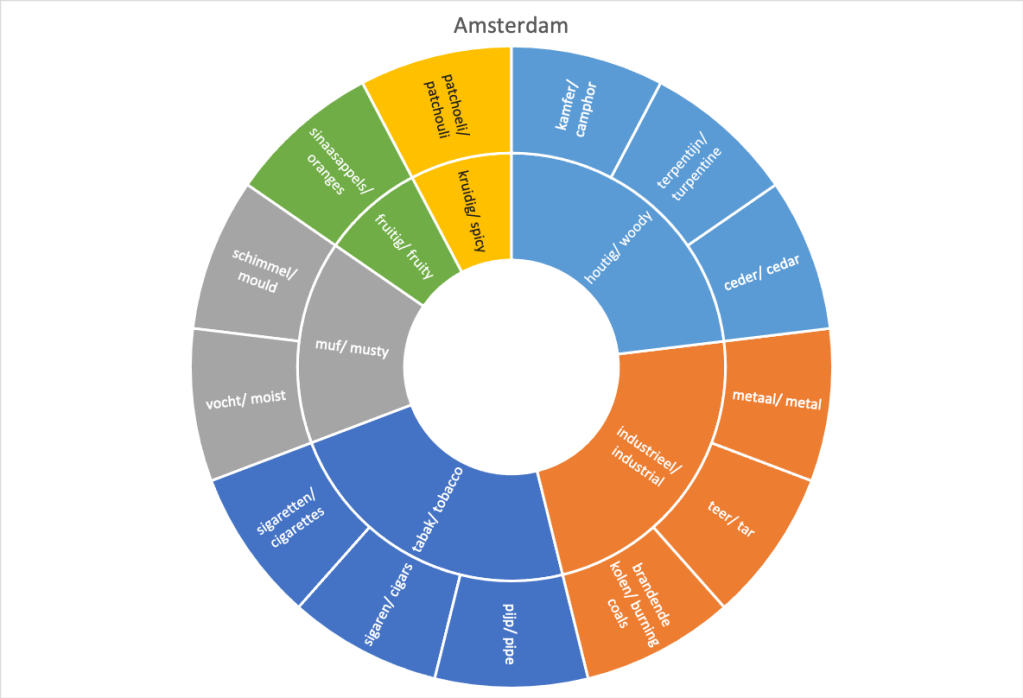
Scent wheel of Mondrian’s studio in Amsterdam, ca. 1909, copyright Caro Verbeek.
At the beginning of his artistic career, Mondrian lived in Amsterdam, where he studied at the Rijksacademie. At this time, he worked in a traditional naturalistic style based on external observation—what he saw around him. He painted still lifes, landscapes, and windmills, often in the dark tones favored by the Hague School. His studio at Sarphatipark was typical of other artists’ spaces of the time, featuring heavy wooden furniture, a coal stove, and a variety of collected objects, such as brassware, masks, vases, Japanese prints, cashmere shawls and Persian carpets.
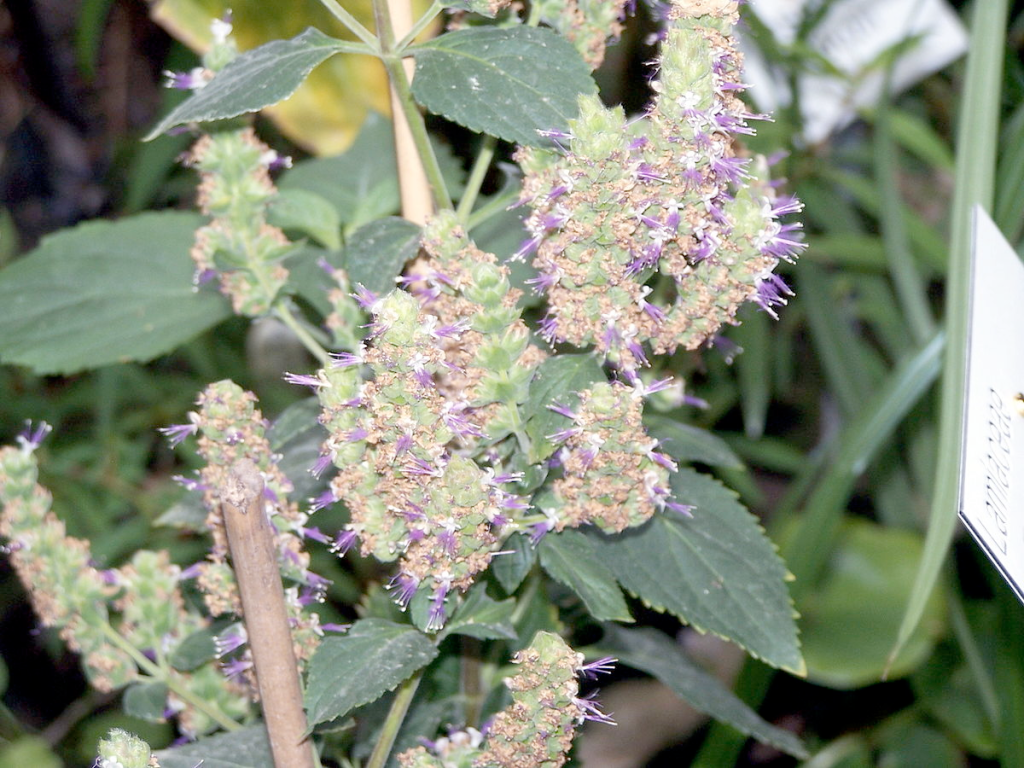
These cashmere shawls – of which he owned several – likely emitted the strong scent of patchouli—a plant with an insect-repellent fragrance. Meanwhile, his textiles likely carried a refreshing camphor aroma, another scent used to protect fabrics. Such aromas were highly exotic to Western noses at the time, having become collectively available to the Dutch through colonialism and globalization.
Patchouli, WikiMedia Commons.
Activities in the studio also left their mark on its scent. Mondrian and visiting artists smoked tobacco, including cigars, pipes, and cigarettes. The invigorating, sharp scent of turpentine—an essential material for painters—likely dominated the air. A faint, damp mustiness, characteristic of Amsterdam houses with their canals and lack of cavity walls, would have formed the base note of the space’s aroma.
Of course, the studio didn’t smell the same every day. Mondrian’s activities created olfactory rhythms, such as when he painted a wall black in 1909. He wrote to Aletta de Iong:
Since I blackened a wall of the studio with coal tar, it smells so much of tar that you might get a headache if I just leave. I thought the air would go away sooner. So should we postpone until next week?
Mondrian would encounter these and other scents again in Paris, alongside entirely new ones.
The Industrial Atmosphere of Paris
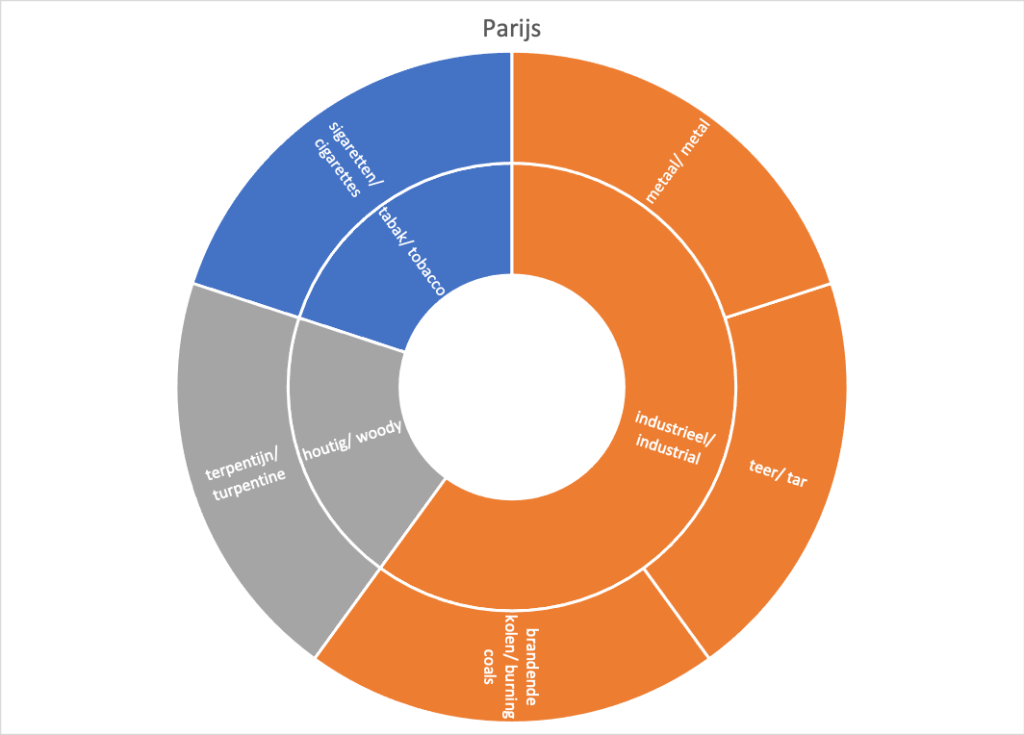
Scent wheel of Mondrian’s studio in Paris, ca. 1919, copyright Caro Verbeek.
In Paris, where Mondrian lived from 1912 to 1938 (with a break during World War I), his work began to take on the style for which he is now famous. Visual reality became less important as abstraction entered his art. His studio on Rue du Départ grew increasingly minimalist and orderly, reflecting his belief that rhythm and movement were closer to life than its visual representation, which he called “costume.” The studio held only essential items: lamps, furniture, painting tools, and a few ashtrays.
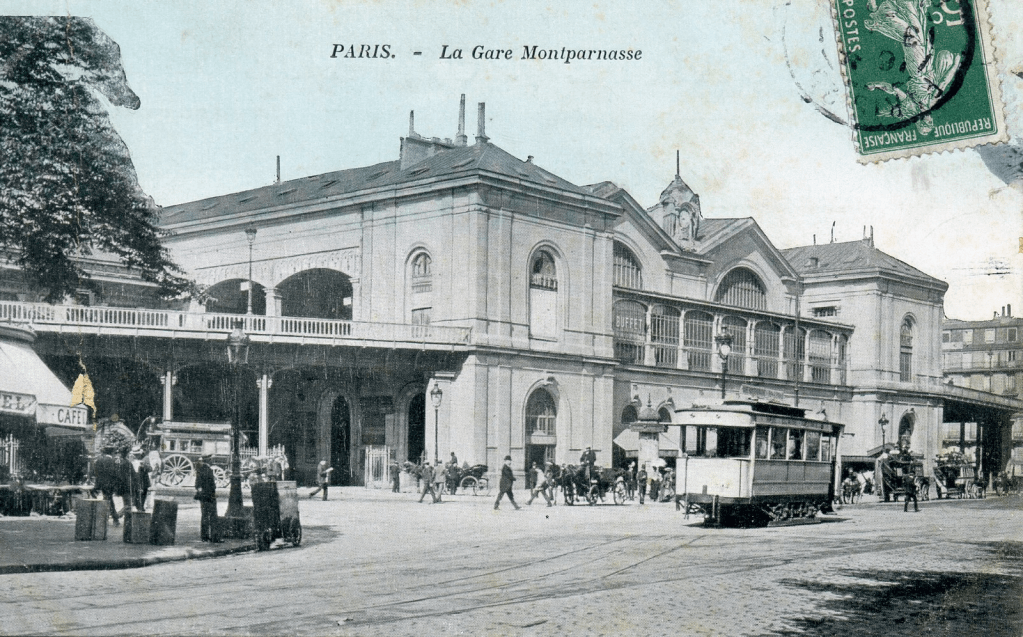
However, the industrial aromas of burning coal, heated metal, smoke, and steam from the nearby Gare Montparnasse likely intruded upon this pristine space. Mondrian had to cover his paintings when opening the windows to prevent a black film from forming on them. Visitors, though, did not seem to notice these industrial smells but instead remarked on the unpleasant odors in the staircase. The smell of tarred rope used as a banister was overwhelmed by the stench from a shared washbasin on the second floor. Michel Seuphor, Mondrian’s friend and art critic, remembered this odor vividly sixty years later:
The courtyard, where the entrance to Mondrian's studio was located, was very miserable. It smelled a bit in the stairwell […].
Painter Wim Schuhmacher also commented on the overwhelming smell:
On the second floor there was a sink for the entire floor and the sink was extremely dirty. Then you would have smelled all that stench and urine and then you came to Piet.
The transition from this foul-smelling space to Mondrian’s open, light-filled studio must have been a literal and figurative breath of fresh air. In winter, the studio smelled of burning coal—if one could afford it—and the city’s outdoor scents filtered in, as Mondrian described in 1920 in his ‘Groote Boulevards’ (Grand Boulevards):
The boulevard is more thought-concentrated. I see the colors and shapes. I hear the sounds. I feel the spring warmth, I smell the spring air, the gasoline, the perfumes, I taste the coffee.
Gare Montparnasse near Mondrian’s studio at the Rue du Départ, WikiMedia Commons.
A Hint of Freedom in New York
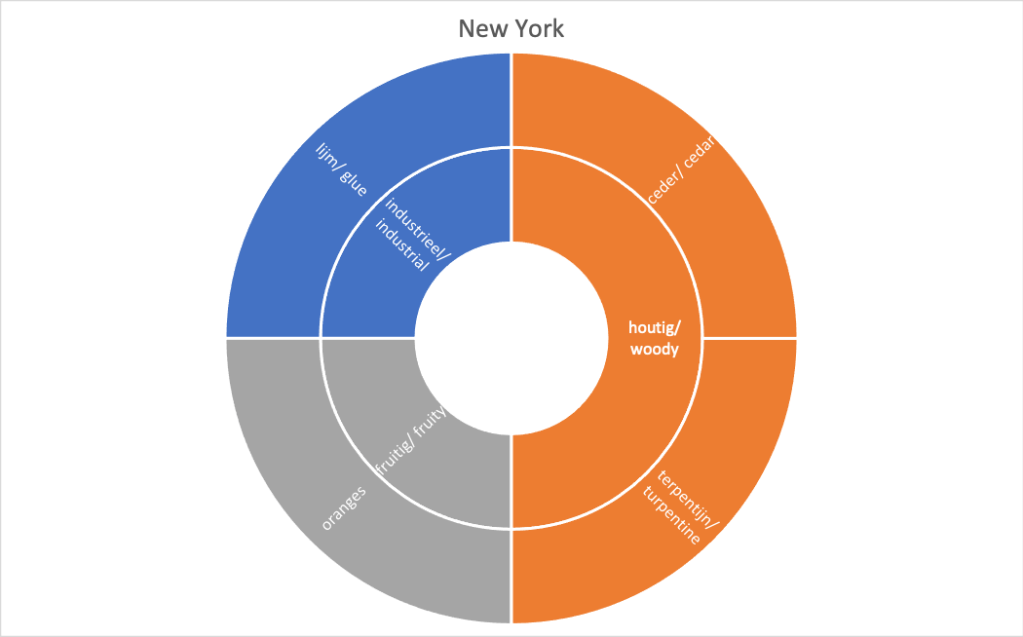
Scent wheel Mondrian’s studio New York, ca. 1943, copyright Caro Verbeek.
Fleeing the Nazis, Mondrian arrived in New York in 1940 after a two-year stay in London. Here, free from the threats of war and persecution, his optimism flourished, influencing a dramatic evolution in his style. The city’s vibrant energy and boogie-woogie rhythms inspired him, and he began using tape as a new medium to make his compositions as dynamic as the music he danced to late into the night.
The invigorating scent of glue filled his studio more prominently than before, alongside the familiar aroma of turpentine. Gone were the smoky scents of coal; the new space had (scentless) central heating. However, Mondrian was not entirely at ease with modern technology: he disliked telephones and found radios complicated, though he cherished his record player. When not smoking a cigarette—which his doctor advised him to quit—his studio exuded a crisp, clear air, reflecting the lightness and simplicity of his abstract works.
This airy studio embodied the clarity and purity Theo van Doesburg had envisioned in 1930:
“An absolute cleanliness, a constant light, a clear atmosphere. […] One can certainly learn more from doctors' laboratories than from painting studios. The latter are cages that smell of sick monkeys.”
Van Doesburg never experienced the pristine scent of Mondrian’s New York studio, having died in 1931. Mondrian himself passed away in 1944 in Murray Hill Hospital, New York, leaving behind his unfinished masterpiece, Victory Boogie Woogie. This painting, a “love letter to the world,” now resides in the Kunstmuseum Den Haag. Its lingering scent of piney turpentine offers a fleeting glimpse into the atmosphere of his studio and life.
Credits: The perfumes were created by Anh Ngo, Birgit Sijbrands, and Bernardo Fleming of IFF, based on research by Caro Verbeek.
An article on the topic appeared in Dutch here: Verbeek, C. (2022), “Kun je abstractie ruiken? – Hoe de geurtransities van Mondriaans ateliers zijn artistieke ontwikkelingen markeren (én bewerkstelligen)”, KM Magazine.
An article in French on the topic appeared here: “Le parfum, une machine à remonter le temps” (ook over ateliergeuren Mondriaan), door Lionel Paillès (29-03-2022) Le Monde
Bernardo Fleming van IFF ruikt aan de geur van Mondriaans atelier in New York.
Technisch gezien bestaan geurstoffen uit een verzameling moleculen die onze neusgaten doordringen. Geuren – hoe ongrijpbaar ook – zijn een materiële weerslag van materialen, activiteiten, gebeurtenissen en daarmee van tijdperken en plaatsen. Maar een geur is ook meer dan dat; zodra geurstoffen in onze neus terecht komen openen ze een enorme onvermoede mentale ruimte die binnenin ons bestaat en die is opgebouwd uit herinneringen en emoties. Daarom kan enkele geur kan ons meer vertellen dan duizend beelden en een enkele ademteug kan ons terugvoeren naar een ver verleden. Ook Mondriaan was gevoelig voor dergelijke prikkels. Mogelijk had zijn geurbewustzijn te maken hebben met het feit dat zijn opa parfumeur (en pruikenmaker) was. Aan zijn goede vriendin Aletta de Iong schreef hij bijvoorbeeld in 1910:
Bloemen vind ik toch zoo iets buitengewoon-heerlijks.Daar op dat plein achter Boymans stonden van de week zulke massa's! Ook de lucht ervan maakt me heel vreemd te moede.
De later in zijn leven blind geworden fotograaf Hannes Wallrafen ruikt aan de geur van Mondriaans Parijse atelier.
In het jubileumjaar 2022 – het 150ste geboortejaar van Mondriaan – vroeg conservator Caro Verbeek van Kunstmuseum Den Haag zich af of het mogelijk zou zijn om geur van de leefomgevingen van Mondriaan te reconstrueren. En dat riep nog meer spannende vragen op. Wat zouden de vervlogen geuren van Mondriaans ateliers in Amsterdam, Parijs en New York ons kunnen vertellen? Hoe verhouden deze zich tot de veranderende wereld waarin deze kunstenaar leefde en zijn kunst? Zouden we heel misschien zelfs zijn ontwikkeling richting abstractie kunnen ruiken?
Bezoekers kunnen dat door een samenwerking met parfumeurs van IFF sinds een paar jaar zelf ruiken en deze vragen beantwoorden dankzij een permanente geuropstelling bij de maquettes van zijn ateliers op de afdeling ‘Mondriaan & De Stijl’. Op basis van onderzoek van onze Mondriaan-conservator (Verbeek, maakten IFF parfumeurs Anh Ngo, Birgit Sijbrands onder begeleiding van Bernardo Fleming een scentscape van drie geuren. Bezoekers melden over die composities onafhankelijk van elkaar dat ze het gevoel hebben naast de kunstenaar te staan in zijn atelier in plaats van er alleen maar naar te kijken en meer empathie voor hem te voelen als een mens van vlees en bloed.
den haag, 7-4-2022, foto serge ligtenberg, Caro Verbeek, de nieuwe Mondriaan conservator met de parfumflessen met parfum die de drie ateliers van Mondriaan verbeelden, Amsterdam, Parijs en New York
De koloniale luchten van Amsterdam
Geurwiel Mondriaans atelier Amsterdam, ca. 1900, door Caro Verbeek
Aan het begin van zijn artistieke loopbaan woonde Mondriaan in Amsterdam waar hij studeerde aan de Rijksacademie. Hij werkte op dat moment nog in een traditionele naturalistische stijl en naar externe observatie, oftewel wat hij om zich heen zag. Hij schilderde stillevens, landschappen en molens die hij aantrof in het gebied dat Het Gein wordt genoemd naar het riviertje dat daar stroomt. Hij deed dat veelal in donkere kleuren, net zoals de schilders van de Haagse School.
Zijn atelier aan het Sarphatipark verschilde niet veel van dat van andere kunstenaars toentertijd. Er stonden zware houten meubelen en er was een kolenkachel. En er bevonden zich allerlei verzamelobjecten, zoals koperwerk, meerdere maskers, vazen, Japanse prenten en ook Perzische tapijten en kasjmier shawls.
Van dergelijke shawls is bekend dat ze hevig naar patchoeli – een plant met een insect-werende geurstof – roken. Mondriaans tapijten moeten juist naar verfrissend kamfer hebben gegeurd; ook al zo’n effectieve geurstof om textiel te beschermen. Dergelijke aroma’s waren in die tijd voor de westerse mens zeer exotisch, want ze werden voor het eerst collectief beschikbaar voor Nederlandse neusgaten als resultaat van kolonialisme en globalisering.
Patchoeli, Wikimedia Commons.
Ook activiteiten laten hun geursporen na. Mondriaan en bezoekende kunstenaars rookten veel tabak zoals sigaren, pijp en sigaretten. Natuurlijk moet ook de opwekkende heldere geur van terpentijn – een onmisbaar materiaal voor schilders – in de ruimte hebben gehangen.
Op de achtergrond is tot slot een ‘basisnoot’ waarneembaar van een licht schimmelige vochtigheid, waar Amsterdamse huizen al eeuwen mee kampten door de aanwezigheid van de vele grachten en het gebrek aan spouwmuren.
Uiteraard rook het niet continu hetzelfde. Er moet sprake zijn geweest van geurritmes, bijvoorbeeld wanneer hij iets veranderde in de ruimte. Zo verfde hij ooit een wand zwart. Hierover schreef Mondriaan zijn vriendin Aletta de Iong in 1909:
Daar ik een muur van ’t atelier met koolteer zwart maakte, ruikt het zóó naar teer dat je misschien hoofdpijn zou krijgen, en ik er ook maar uit ga. Ik dacht dat de lucht gauer weg zou gaan. Willen we dus maar beter uitstellen tot volgende week?
Mondriaan zou deze en andere geuren, opnieuw aantreffen in Parijs, maar ook andere dienden zich aan.
De industriële sfeer van Parijs
Geurwiel Mondriaans atelier Parijs, ca. 1919. Door Caro Verbeek
In Parijs – waar Mondriaan tussen 1912 en 1938 (met een onderbreking tijdens WOI) kreeg zijn werk steeds meer het uiterlijk waar het tot vandaag de dag zo bekend om staat. De visuele werkelijkheid wordt steeds minder belangrijk en abstractie doet zijn intrede. Zijn atelier aan de Rue du Départ werd rond 1919 net als zijn composities steeds eenvoudiger, leger en lichter. Ritme en beweging staan volgens hem dichter bij het leven dan de visuele weerslag ervan die hij ‘kostuum’ noemt. Er bevonden zich nu alleen nog noodzakelijke voorwerpen zoals lampen, meubels en schilders-attributen in zijn atelier (en natuurlijk een paar asbakken)
De geur van brandende kolen, verhit metaal, rook en stoom van het nabijgelegen station Montparnasse moet die bovenaards ordelijke, en smetteloze omgeving toch wat hebben verstoord. Mondriaan moest zijn schilderijen afdekken wanneer het raam openstond zodat er geen zwart laagje op kwam.
Prentbriefkaart Gare Montparnasse
Maar bezoekers van zijn atelier klaagden – waarschijnlijk door gewenning – niet over deze industriële lucht, maar meldden wel de stank die in het trappenhuis hing. Kennelijk maakte die een diepe indruk. De geur van het geteerde touw dat als trapleuning diende, werd er zelfs door overstemd. Zijn goede vriend en kunstcriticus Michel Seuphor herinnerde zich zestig jaar na zijn laatste bezoek die vervelende lucht nog:
Het binnenplaatsje, waaraan de opgang naar Mondriaans atelier lag, was heel miserabel. In het trappenhuis stonk het een beetje […].
En hij was niet de enige die die geur nauwelijks kan verdragen. Volgens schilder en tijdgenoot Wim Schuhmacher was het op de gang nauwelijks te harden:
Op de tweede verdieping was een wasbak […]voor de hele verdieping en die bak was bijzonder vuil. Dan had je dus al die stank en urine geroken en dan kwam je bij Piet.
De overgang van deze meurende ruimte naar het open, heldere en verzorgde atelier van Mondriaan moet zowel letterlijk als figuurlijk een verademing zijn geweest. De grootstedelijke walmen vielen zoals gezegd waarschijnlijk nauwelijks op en in de winter rook het – als je daar geld voor had tenminste – ook binnen naar brandende kolen.
Mondriaan had in Parijs overigens ook aandacht voor de geuren in de buitenlucht. In 1920 schreef hij in zijn literaire tekst “De groote boulevards”:
De boulevard is gedachtegeconcentreerder. Ik zie de kleuren en vormen. Ik hoor de geluiden. Ik voel de lentewarmte, ik ruik de lente lucht, de benzine, de parfums, ik proef de koffie.
Een vleugje vrijheid in New York
Geurwiel Mondriaans atelier New York, ca. 1943. Door Caro Verbeek
Op de hielen gezeten door de nazi’s kwam Mondriaan – na een tweejarig verblijf in Londen – in 1940 aan in New York. Hier hoefde hij niet langer te vrezen voor de oorlogsgeweld of vervolging. Zijn stijl veranderde door een hervonden optimisme voor de laatste keer behoorlijk, ook onder invloed van het bruisende stadsleven en natuurlijk de opzwepende ritmes van de boogiewoogie.
Mondriaan ontdekte hier tape als nieuw medium, zodat hij zijn composities even speels en dynamisch kon maken als de muziek waarop hij tot in de kleine uurtjes danste.
Dat betekende dat de opwekkende geur van lijm in veel hogere concentraties aanwezig was dan ooit tevoren, terwijl terpentijn als oude bekende aanwezig bleef. En wat te denken van de wasdoek (een doek bedekt met was) waar hij op danste midden in zijn atelier? Ook verdwenen er bekende geurelementen. Mondriaan woonde niet langer naast een druk station en de kolenkachel had in deze nieuwerwetse wereld plaats gemaakt voor (geurloze) centrale verwarming. Overigens wist de normaal zo toekomstgerichte kunstenaar niet goed wat hij aan moest met al die moderne spullen. Telefoneren deed hij liever niet en een radio vond hij ingewikkeld, maar een platenspeler bleef onmisbaar. De atmosfeer in zijn atelier was nu – als hij even geen sigaret rookte, wat hij op doktersadvies ook moest staken – even helder, fris en ‘vlak’ als zijn doeken en niet langer een rijk potpourri aan zware luchten.
Palet met witte verf van Mondriaan, ca. 1938, collectie Kunstmuseum Den Haag[CV2] .
Dit is de lichte, klare geur van het overboord gooien van alle ballast. En van een vrolijke en kleurrijke abstractie! Zijn atelier rook nu eindelijk naar het laboratorium dat zijn vroegere collega Theo van Doesburg vanaf 1930 ambieerde:
“Een absolute reinheid, een constant licht, een klare atmospheer. […] Men kan voorzeker meer van dokterslaboratoria leeren dan van de schildersateliers. Deze laatste zijn kooien waar het naar zieke apen stinkt”.
Van Doesburg heeft zelf de kristalheldere geur van Mondriaans New Yorkse atelier niet meer kunnen opsnuiven. Hij stierf in 1931 en hun vriendschap was vóór die tijd al verwaterd. Mondriaan blies begin 1944 zelf zijn laatste adem uit in een ander ‘dokterslaboratorium’, namelijk het Murray Hill Hospital in New York. In zijn atelier bleef zijn ‘liefdesbrief aan de wereld achter’; het net niet afgemaakte schilderij Victory Boogie Woogie. Dit werk zou nadien – anders dan zijn maker die nooit meer zou terugkeren – wel vijf keer de oceaan oversteken, vóór het in 1998 zijn definitieve plek vond bij ons in Kunstmuseum Den Haag. De denneachtige geur van de terpentijn die vandaag de dag nog ruikbaar opstijgt uit de verf vertelt ons over de – nog niet helemaal – vervlogen lucht van zijn leefsfeer en zijn werk.
Murray Hill Hospital
Credits
De parfums werden gemaakt door Anh Ngo, Birgit Sijbrands en Bernardo Fleming van IFF op basis van onderzoek van Caro Verbeek (Kunstmuseum Den Haag).
De geurstations werden gemaakt door Jorg Hempenius van iScent (flessen met pompen) en Berend Visser van Kunstmuseum Den Haag (houten meubeltjes).
In de media
De programmamakers van ‘Gymnastique’ van Tv-zender Arte maakten een documentaire over de geuren van Mondriaans ateliers (zie hier: https://www.arte.tv/fr/videos/105628-001-A/gymnastique/). Ook door nationale en andere internationale pers (Le Monde, The New York Times) werden de scentscapes opgepikt.
Zie ook het eerder verschenen artikel: Verbeek, C. (2022), “Kun je abstractie ruiken? – Hoe de geurtransities van Mondriaans ateliers zijn artistieke ontwikkelingen markeren (én bewerkstelligen)”, KM Magazine
by Dr. Caro Verbeek, sensory historian and curator
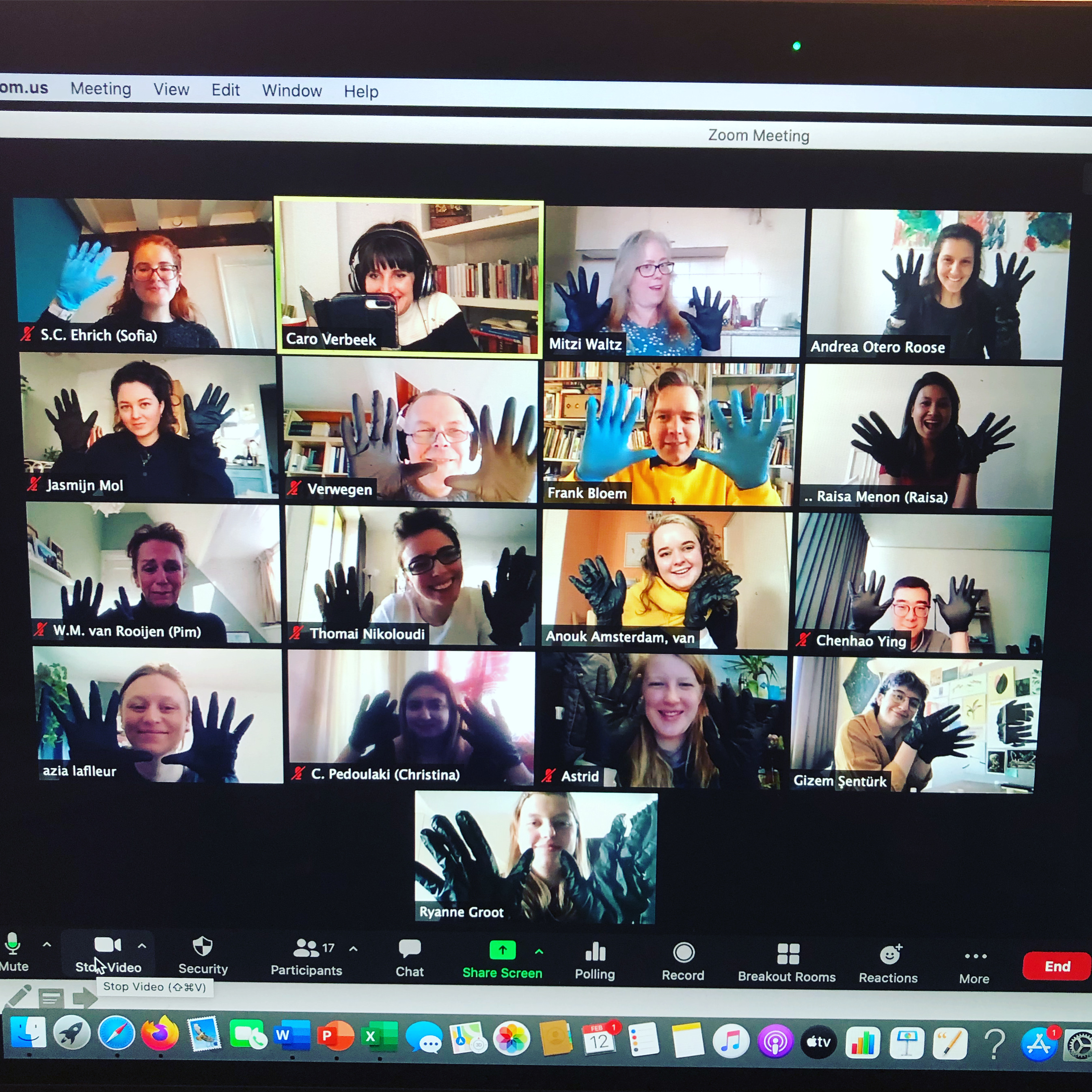
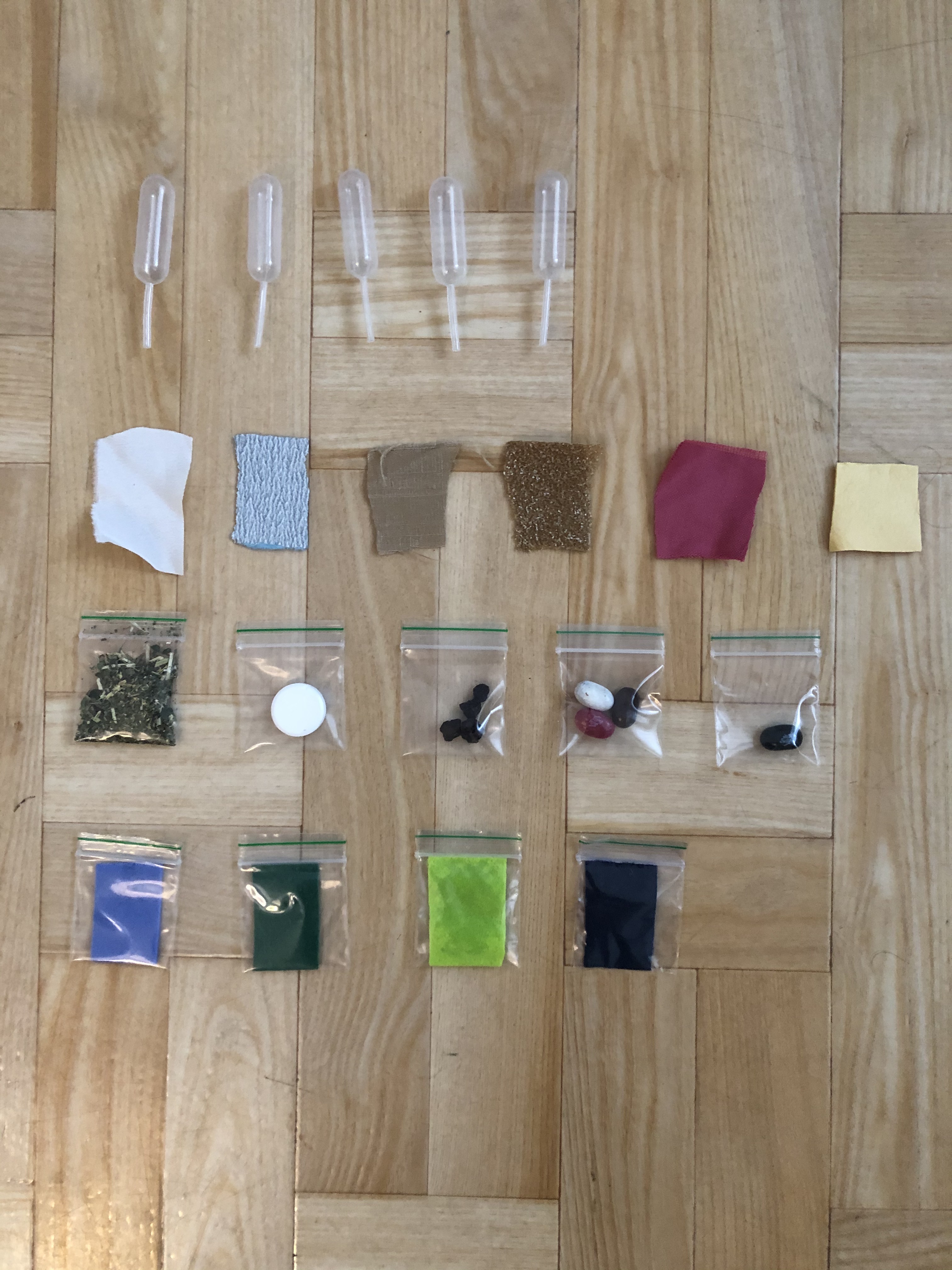
Before I founded and designed the course ‘Knowing by Sensing’ in 2019, I had to overcome quite a few obstacles. First of all, sensory learning is associated to the education of children and not to serious academic students. And second of all, smelling, tasting and touching are traditionally not considered as instruments leading to proper knowledge. I was convinced it could work though, and I am glad I persevered, and met the right people. When (then) head of education of Vrije Universiteit saw me lecture on the senses (and through the senses!) to inaugurate the academic year in 2017, he invited me to think about a course that could benefit all types of students. My highly supportive PhD-supervisor Inger Leemans saw an opportunity and allowed me to further develop this course, which I labelled ‘Knowing by Sensing’. Inspired by the already existing movement of ‘Knowing by Doing’ I opted for this title because knowledge and experience are all to often deemed opposites. Which they are clearly not, because they always inform each other! The third obstacle was Covid-19. How can one teach smell, taste and touch online? Why, by making a sensory kit of course!
Background
I had already started to inroduce scents and other sensory impressions in the classroom in 2010 in my course ‘The Other Senses’ at the ArtScience Interfaculty (KABK the Hague). And what I noticed amazed me: smells and tactile impressions truly help to keep students more engaged, active and inquisitive and they remembered the studied material more easily! Why wouldn’t this work for academic students?
Messages and information conveyed through the senses in combination with textual cues, have a better chance of being understood and processed since this method caters to different learning styles. Furthermore, sensory engagement enhances
Inclusivity and accessibility
Empathy for people that experience the world differently
aesthetic appreciation
community building
historical sensations
emotional states (and emotional are essential for learning)
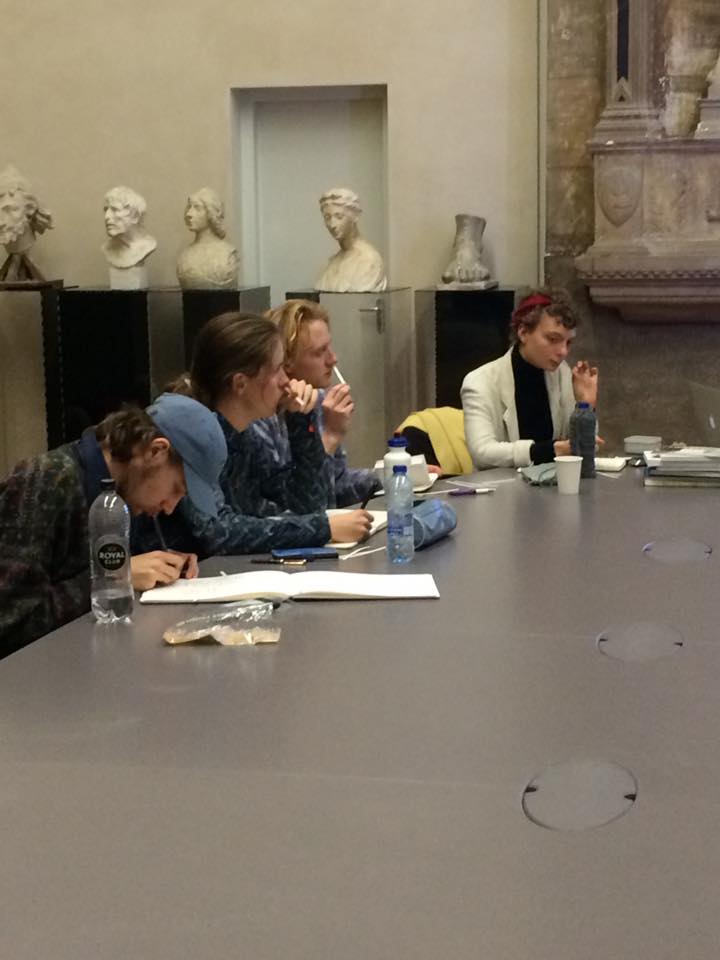
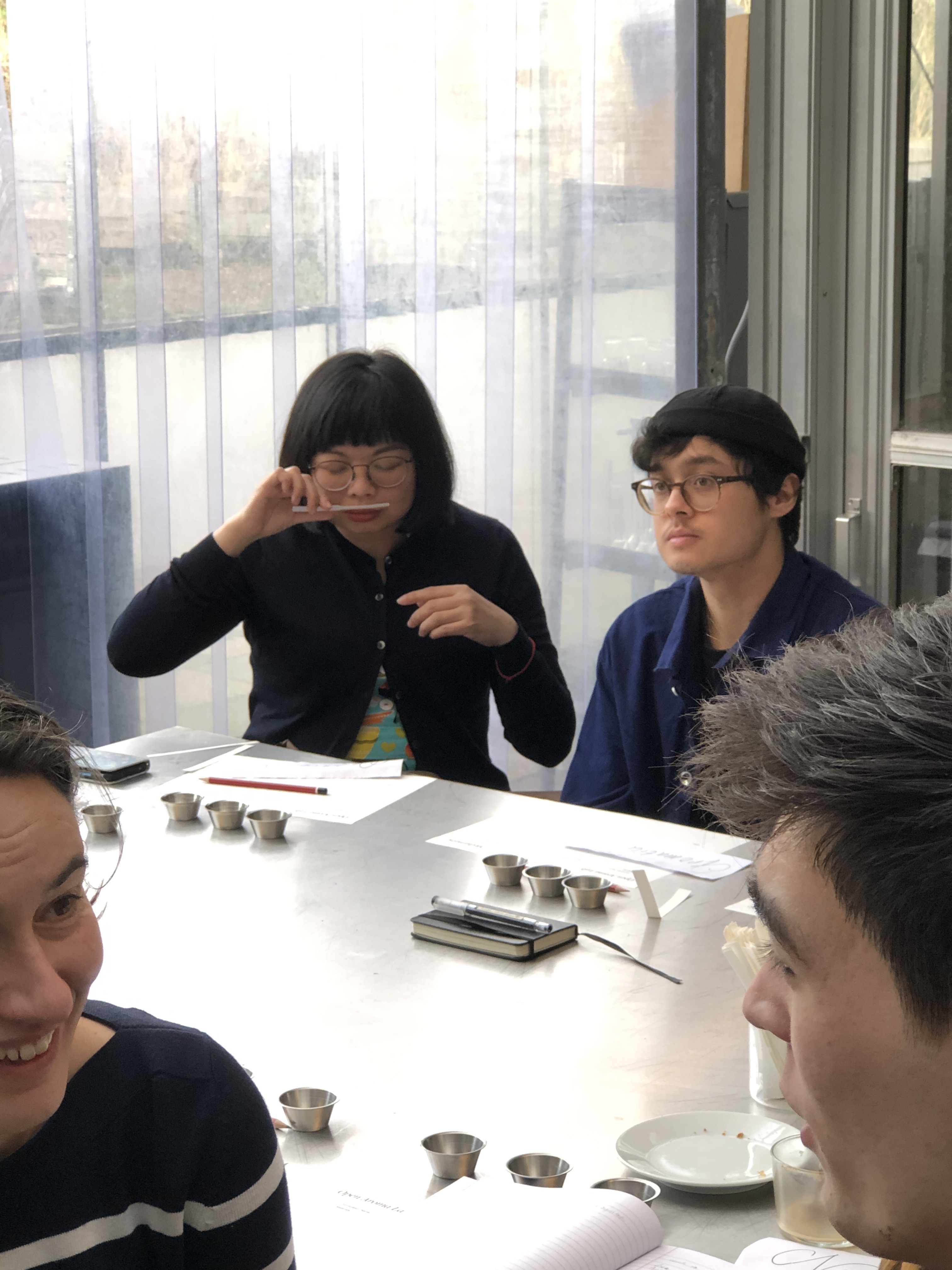
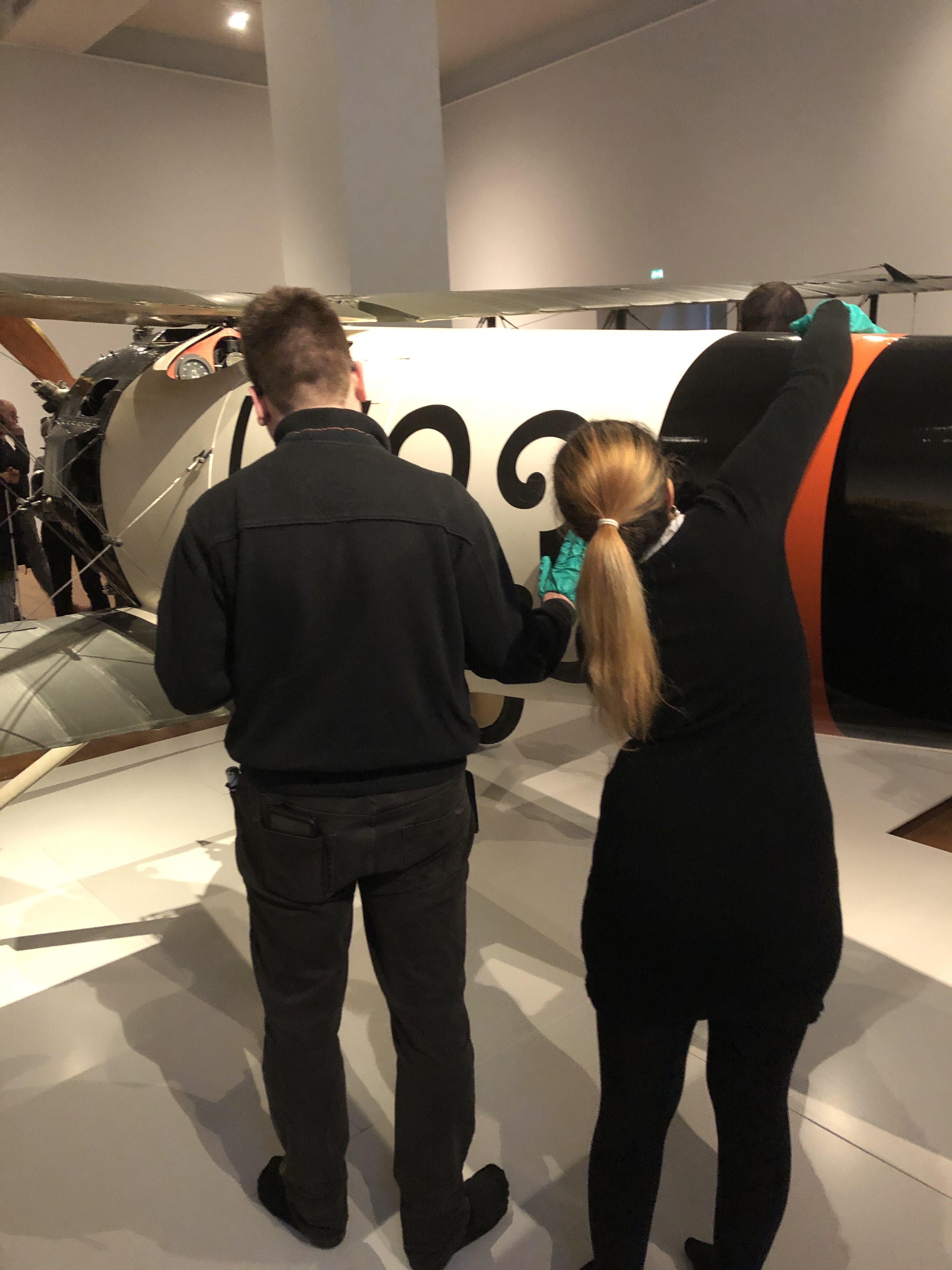
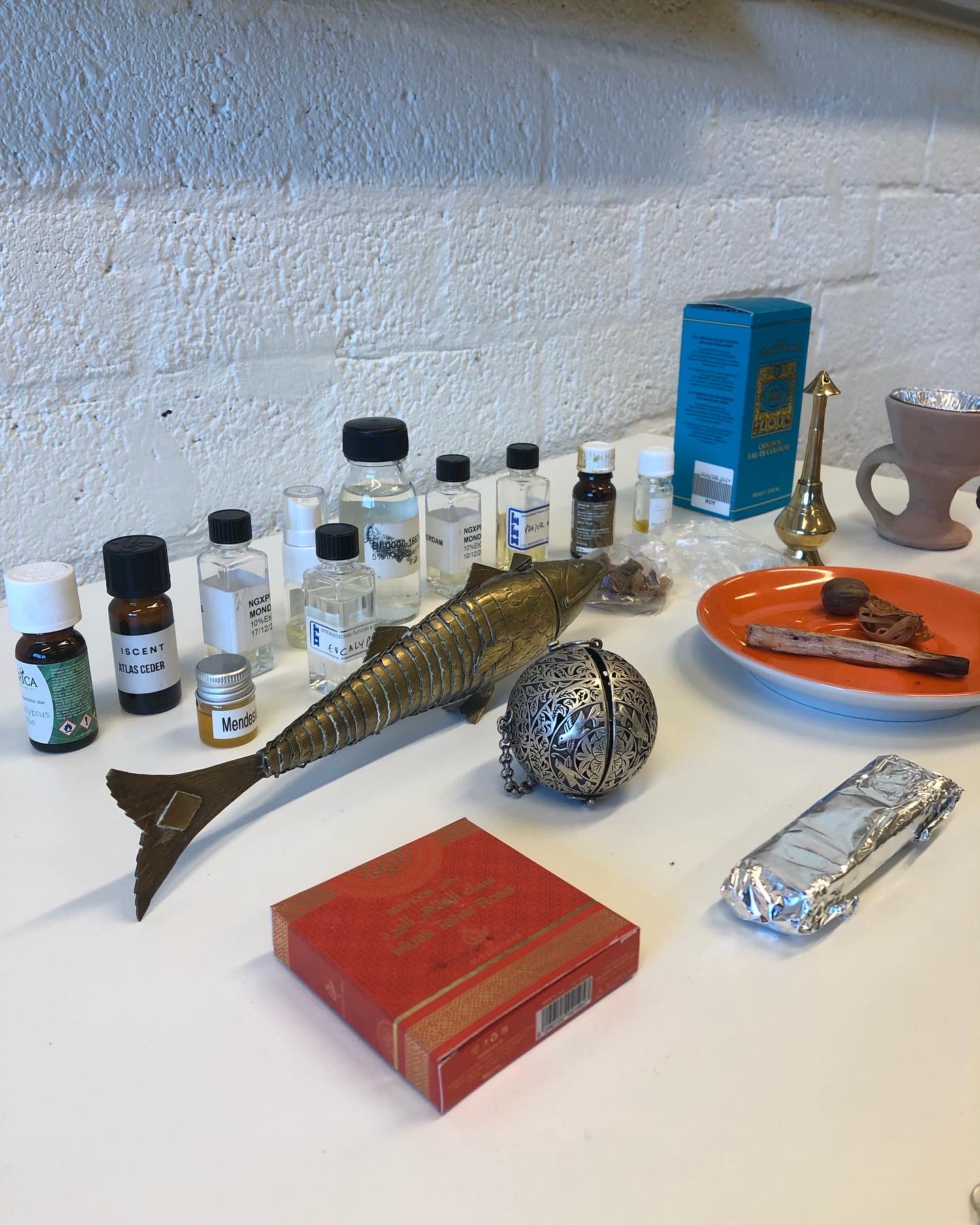
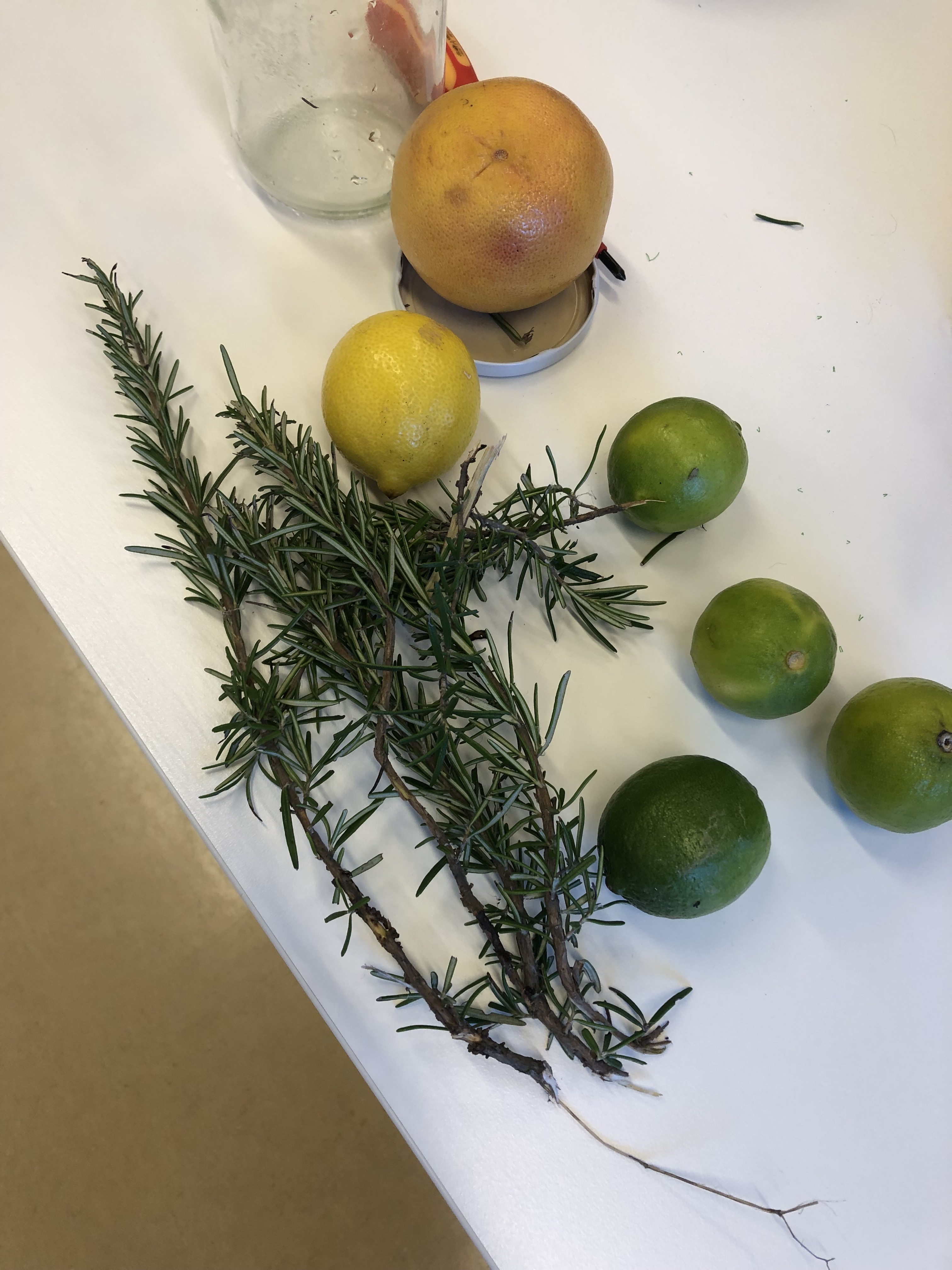
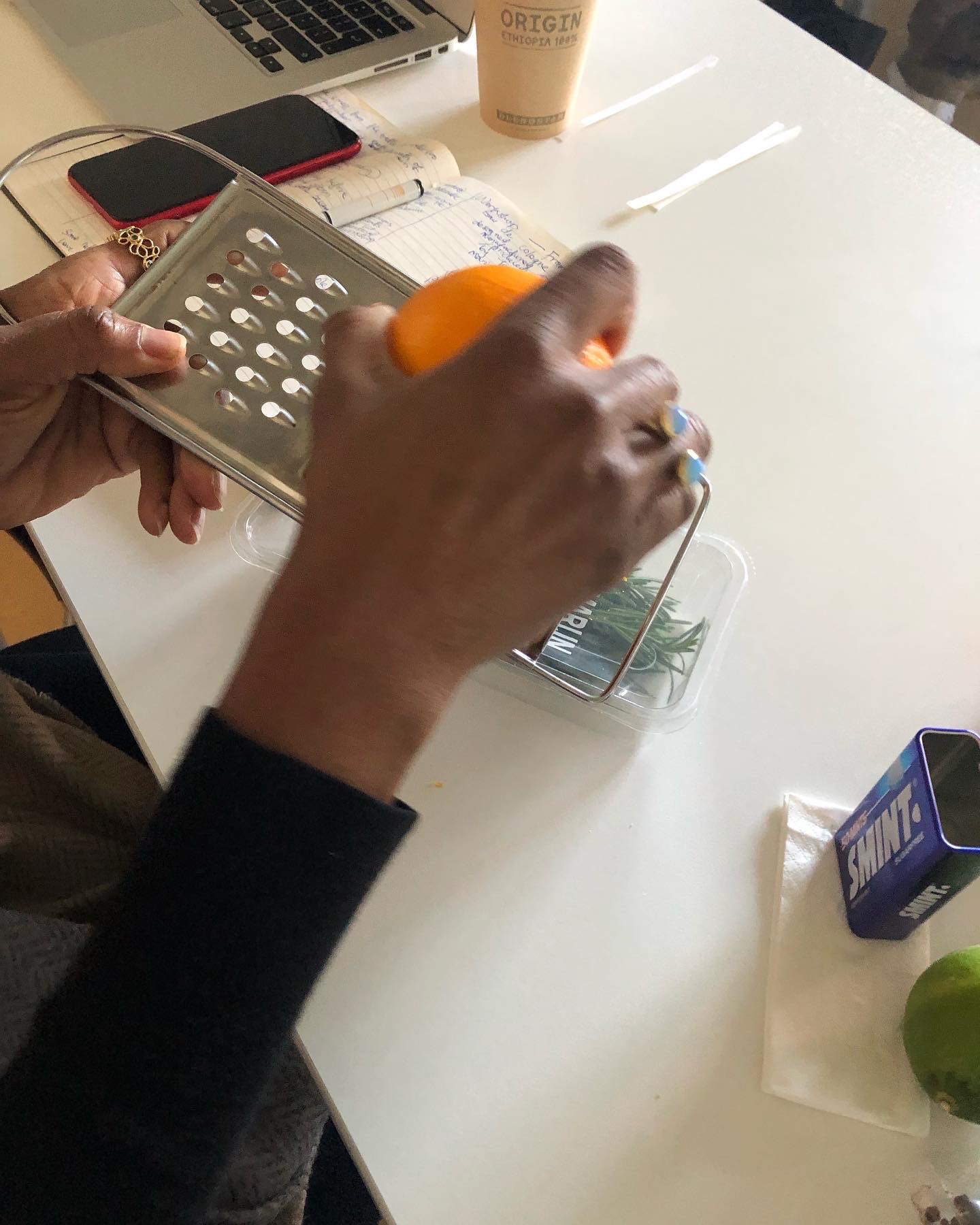
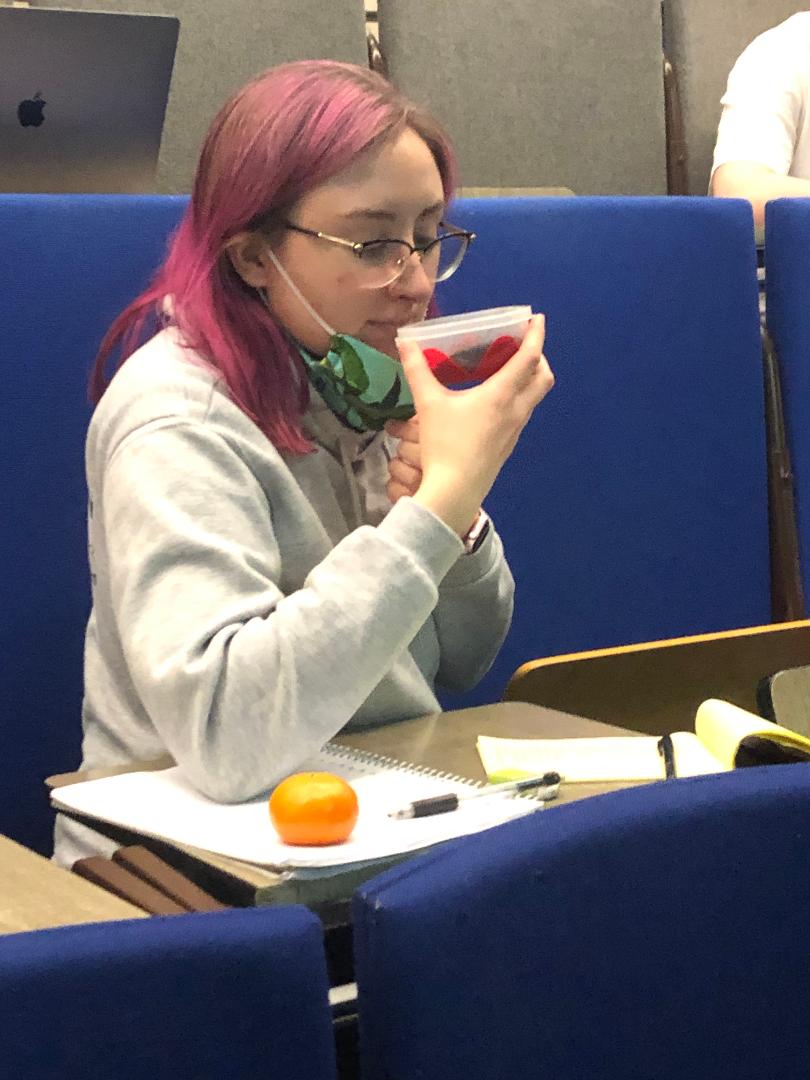
During this course – which is assessed as ‘excellent’ and followed by both medical, heritage, art and communication students – we train our senses, discover ‘new’ senses’, learn how to describe sensory experiences and how to integrate them in exhibition design and care environments to enhance inclusivity and well-being. We sniff historical scents, create our own perfume, taste wine, listen to ancient organs, embody sculptures and find out about our internal sense of proprioception.
ARTTVARKS
I would like to call this multisensory learning style arttvarks! And it tries to leave no sense unaddressed:
What follows is a visual report of the many things we did over the years, but only after mentioning these amazing contributors:
Dr. Hans Fidom – deep listening
Michiel Huijsman – deep listening
Cathelijne Denekamp (feeling, audiodescription, inclusion and museology)
Romy Muste (embodiment in museums)
Dr. Piet Devos (haptics and disability studies)
Dr. Ilja Croijmans (olfactory language and tasting)
Frank Bloem (perfumery and smell)
Sandra Schouten (sensory care)
Dr. Cretien van Campen (synaesthesia and sensory memory)
Dr. Wouter de Vries (imagination, and coordination in the first year)
Dr. Manon Parry (for integrating this course in her track)
Last but not least, I would like to thank my former student and trainee Sofia Ehrich for succesfully teaching my course in 2024 while I was not available and prof. dr. Inger Leemans for giving me the chance to develop this course and to elaborate on the method later on.
I myself (Caro Verbeek) am specialised in touch, smell, sensory museology and synaesthesia.
These lyrics are by the poet and musician Nick Cave. The song ‘Christina the Astonishing’ is about the life of an almost forgotten saint known in Dutch as Christina de Wonderbare (ca. 1150-1224). Christina was labeled a witch and considered mad during her lifetime. But she was also accepted as clairvoyant, she performed miracles and was eventually canonized after dying (which she experienced no fewer than three times). She became the patron saint for both caregivers of people suffering from mental illness and those with mental problems.
The miracle and the stench of sin
This Mystic led a tragic life. Firstly, her parents died when she was only fifteen. Not much later she died herself. However, during the funeral she miraculously rose from the dead. Those present must have had the shock of their lives when she suddenly sat upright in her coffin. Their surprise was probably even greater when she turned out to be able to fly. She ascended into the vault of the Church of Our Lady in Sint-Truiden and only came down again when the crowd left and the priest ordered her to descend. In an old Flemish text, she was compared to a bird for this reason:
She had good reason for staying there. During her death, she had experienced something miraculous, which today would be called a near-death experience by experts in this field such as Pim van Lommel. Angels had taken her – as Virgil later did with Dante Alighieri in his ‘Divine Comedy’ – to hell and purgatory. There she was given the choice of ascending to heaven or returning to the land of the living. She chose the latter.
Phantosmia
Strangely, her adventure had altered her sense of smell. Her nose was able to detect sin like an overpowering stench. That caused her a lot of discomfort, because sinners turned out to be omnipresent. The fact that the Miraculous could smell sin so well was not in itself an expression of an extraordinary gift. Anyone was able to do that according to contemporary theological insights. Earthly stenches (and also fragrant aromas) were a wordly manifestation of the transcendental, of the forces governing the beyond, because scents were attributed the ability to bridge the gap between heaven and hell and earth. What was exceptional was that her sensitivity to it appeared to be enormously increased.
Perceiving odorants that are not ‘there’ (i.e. that others do not smell) is called ‘phantosmia’, derived from the Greek ‘phantasma’ or ‘imagination’ and ‘osme’, which means ‘smell’. Phantosmia can occur due to brain injury, a cold, the coronavirus or brain tumors. The composer George Gershwin (1898-1937) regularly smelled burnt rubber in the weeks before he died. He eventually died after brain surgery which was performed to remove a tumor from the temporal lobe. Mirabilis could well have been in ‘suspended animation’ after a stroke; something that indeed provides a medical explanation for her olfactory condition and paralysis.
But the cultural context also makes the theological explanation understandable and valid. After all, perception (and its value) is always linked to beliefs that are both individual and collective in nature and do not only concern synapses and nerves. In other words, perception occurs not only through our senses, but also through mental interference.
Good and evil; a matter of the nostrils
Now, even before her (first) death, Christina was quite averse to being close to people. She spent her time with the cattle she herded in the Brustem fields, where she also devoted herself to prayer and meditation. Her remarkable choice to subsequently live among the birds in the treetops can be explained by both her human-shy nature and her aversion to the pungent scent of sin. But it also has to do with her preference to be among animals, above those of her kind. She is also said to have slept in pigpens and to have shared meals with them. The fumes from that pigsty were apparently still better than the malodorous stench that humanity exuded. Her – much better known – contemporary Franciscus of Assisi (1181-1226) had a preference for animals, just like her. He preached to the birds and befriended a wolf. The tendency towards the animal and the sacred are therefore not mutually exclusive. A big difference with Christina is that she also seemed to behave like an animal (and probably smelled like one), while Franciscus could mainly speak to them, or in other words engage with them in an almost intellectual way through language, although it was clear that he felt great respect and affection for his fellow earthlings.
Devilish shit
Cave emphasized the sorrows of Christina by singing “The stench of human sin/ the stench is more than I can bear.” That sinfulness would have a certain smell is not something that fell from the sky, as has just become clear. It already had a long theological tradition that was extensively researched by historian Susan Ashbrook Harvey. In her book Scenting Salvation, she discusses how for centuries in Christianity it was believed that sweet smells belonged to the realms of heaven and the divine, and how stench reminded people of the earthly and the fallen state of man since original sin. The source of that stench was always the devil or human immorality. And that stench did its job:
There are even several documented malodorous incidents that were directly linked to the devil. A very beautiful one has to do with the relics of the virgins of Saint Ursula:
So Mirabilis was not just a pathetic ‘poser’ who turned up her nose at unpleasant odors. The malodorous was embedded in the belief system and life of medieval man. An evil smell – it was commonly thought – even made it impossible to practice one’s faith, because it was not only a symptom of satanic practices and sin, but also had agency and exerted its negative influence.
From an unexpected source we find a recent legacy of the way of thinking that smell had to do with morality and behavior. The philosopher Nietzsche (1844-1900) – in whom madness and genius also coexisted – stated that his wisdom was located in his nostrils (“Mein Genie ist in meine Nüstern”) and that it was possible to smell whether someone had good or bad morals, as Adam Westra argues in his article “Nietzsche’s Nose”.
Divine pleasure
Seven years after her death, in 1231, the monastic community of Christina Mirabilis moved to NonnenMielen (then Mielen). Of course, the saint’s body had to move with it. A crowd of worshipers had gathered for this event. And when the lid was pushed off her coffin, the bystanders witnessed an aroma of a completely different nature than that which had plagued the saint for some forty years:
In the Middle Ages, this unctuous air was referred to as ‘odor of sanctity’. Those present received a foretaste of paradise in which, among other things, the ‘tree of life’ and the ‘tree of knowledge of good and evil’ exhaled their own perfumes according to the Christian faith (as was researched by Susan Ashbrook Harvey). It is fascinating how both olfactory extremes play a role in the life story of this saint. Yet this was simply an expression of how essential aroma and stench were in thinking about and understanding a world that was generally believed to be ruled by the opposites of good and evil, heaven and earth. Christina – just like scents themselves – seemed to bridge all these domains effortlessly.
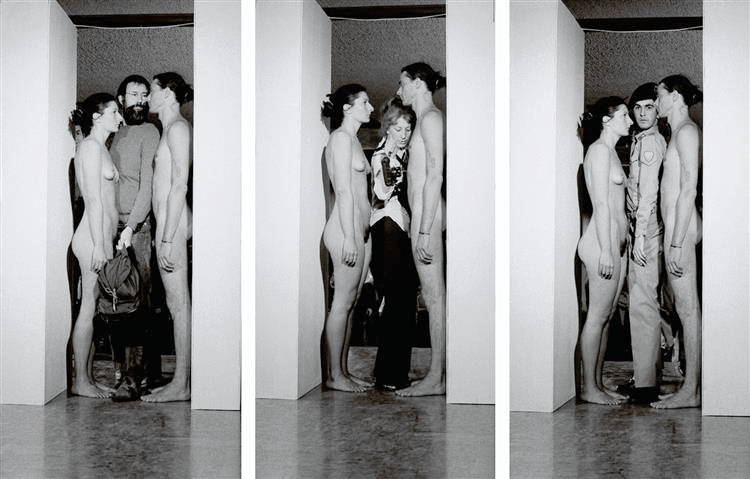
‘In a chosen space. We are standing naked in the main entrance of the Museum facing each other. The public entering the Museum has to pass sideways through the small space between us. Each person passing has to choose which one of us to face’.
With these words Marina Abramović described the circumstances for the performance Imponderabilia, which was first held at the Galleria Communale d’Arte Moderna in Bologna in 1977 and which she performed together with Ulay (1943-2020). That specific performance went as follows:
Even before entering, the visitor encounters an enormous barrier. A physical threshold has been replaced by a mental obstacle: two bodies that provide just enough passage to pass sideways. The biggest difficulty factor is determined by the lack of their clothing. The artist duo Ulay-Abramović stands naked in the narrow doorway; she with her back against the right post, he against the left. They look at each other continuously. Their gazes seem to fill the empty space with a solid impenetrable substance that you don’t want to end up in. Once inside, the visitor is confronted with a statement on the opposite wall:
‘Imponderables. Such imponderable human factors as one’s aesthetic sensitivity/ the overriding importance of imponderables in determining human conduct’.
This sentence makes clear that the actual work of art does not (just) consist of the bodies of two artists present, nor even the situation, but the behaviors and reactions of the audience. After a few hours local policemen put an end to the performance. According to them, the artists were breaking the law by standing on the threshold of public space exhibiting their bodies. Had they been all the way inside, they would not have broken any official law. And this didn’t even include all the unwritten behavioural rules they addressed and that made this piece so compelling.
Counting what counts – numbers and observations
Directly opposite the entrance where Ulay and Abramović are standing, a hidden camera has been mounted to document the performance. And I meticulously counted and analyzed every single interaction that was filmed.
The compilation shows 323 people passing by; 141 women and 182 men. Each of them is confronted with the choice of whether they will pass towards the male or female body, while the other body also remains clearly palpable. The prediction that the majority, both men and women, would pass with their bodies towards Abramović, turns out to be correct. 216 out of 323 people make this choice. It is striking that relatively more women focus on Ulay, namely 40 percent. For men this is less than thirty percent. So you can say that no less than 40 percent of women choose the opposite sex, compared to 70 percent of men. Although touching of both nudes cannot be prevented, most people still try to make themselves as small as possible, keep their hands close to them, and walk quickly.
Unique responses
There were also a number of unique reactions (in the sense that they only occurred once). The video shows people on the street through the glass wall who keep walking back and forth and looking, but who do not dare to enter. An older woman with a walking stick, who hesitates for several minutes, finally squeezes between the two giants and gasps for air, making it seem as if she is drinking from Abramovic’s nipple like a small child, which looks quite grotesque, yet poetic.
My favourite occurrence is when a man avoids the difficult choice altogether by not choosing a side, but walking straight ahead. He consequently gets stuck and now has to put up even longer with a situation that clearly makes him feel uncomfortable. When he finally manages to get out of his tight position, his backpack gets stuck. Once he breaks free, he quickly gets away as though fleeing a fire.
Only a few people feel ‘unashamed’ enough (or they try to demonstrate it forcibly) to voluntarily and very consciously touch one of the artists with their hands. This is limited to men grabbing Ulay’s and women touching Abramović’s shoulder. A brave woman kisses the artist on the cheek as she passes. Possibly she is someone they know? And also striking: eye contact, or even directing the gaze to another part of the body, is scrupulously avoided. Only two men keep their eyes on Marina’s breasts as they pass. Wearing sunglasses obviously makes this easier.
Although the majority tries to avoid the subject of the – quite attractive – nudes as much as possible, there are four people who do not ignore the erotic aspect and even seem to exploit it (I noticed this during a reenactment in 2024 at the Stedelijk Museum. A man passed facing the attractive young woman and carefully examined every inch of her face while he did so. I was quite shocked). This corresponds to approximately two percent of the audience. Most striking is a woman who tries to take control of the situation by behaving in a noticeably flirtatious manner. Very slowly and with her eyes piercing those of the artist (they are about the same length), she brushes her body against Ulay’s, after which she looks back again and then steps away very elegantly, as if to show that the roles have been reversed and no one can force an unwanted feeling on her. On the other hand, a man seems to consciously lean against Abramović’s body a little longer. He drops to his knees, causing their breasts to touch each other exactly. Because the camera’s microphone is too far away from the people passing by, it is difficult to find out what passing visitors that are clearly speaking are saying. The lip-reading spectator can deduce ‘Scusi’ (excuse me) from the moving mouth of a man who wants to leave the gallery, gets stuck and has contact for longer than the average two seconds. The artists completely ignore him. He is forced to stay…
Unwritten rules and invisible boundaries
Every individual is surrounded by an invisible personal space that should not be exceeded in the interest of privacy and common decency. Only public situations in which people are forced to stand close to each other, such as in crowded public transportation or during a busy concert, justify violating this unwritten rule, although not always without arousing a feeling of unease. Getting too close when the available space allows another option is an outright taboo (this often happened to me as a young student in Florence where men pushed their bodies against mine in supermarkets and buses even if those were virtually empty).
Nudity in a public space is also experienced as inappropriate, unless there are specific conditions. One of them is the collective character, or the fact that no one wears clothes. A second justification for showing the naked body, for which the first condition does not have to be a prerequisite, is the necessity for it, either practically (the doctor’s visit, the sauna, the massage) or mentally (the nudist beach). But even when there is consensus in a given situation about nudity in public spaces, people will generally avoid touching the naked body of the other (except at the orgy). Within many cultures there is a collective awareness of all these unwritten conditions. With their performance, Ulay and Abramović consciously violate a number of written and unwritten rules of appropriate behavior in public space. First of all, everyone is dressed except for them. Secondly, they show their nakedness in public space without any ‘necessity’. But the visitor also voluntarily breaks a rule. He or she is not forced to enter the invisible personal space of the artists. Although the visitors of the performance were not informed in advance of the taboo-breaking action and arrived ‘unknowingly’, the choice to leave remains free. In order to make the trip to the museum worthwhile and not miss out on the resulting anticipated art experience, he or she may be more likely to take the step. People assume that the actual exhibition is behind the threshold and that the ‘reward’ will therefore follow (this is the reason the performance can never be truly reenacted; people often already know the outcome of the performance). Moreover, everyone sees his predecessor doing the same, which makes it a bit easier. Due to the continuous flow of visitors, they enjoy a certain anonymity in the crowd. The visitor then consciously chooses to conduct unaccepted behavior, which is approved by the artists, but is nevertheless inappropriate due to the conditioning circumstances and therefore feels very uncomfortable, even unpleasant to some. With the forced palpitation of the naked body in public, attractiveness can transform into discomfort or even fear. This feeling may also be related to the culturally determined fear of transmitting infections.
The ‘other’ senses
In this performance, touch transcends pure sensation or its role as a mere medium. In her famous ‘Das Material der Kunst’ (The Material of Art), art historian Monica Wagner describes the role of touch in Imponderabilia as a ‘sense of the whole body’ and considers contact with the naked body a material. Touch, even more than sight, gives meaning to the conceptual and concrete content of this performance, as I may add. Touching becomes an equivalent to breaking the previously discussed (un)written rules. The relationship that touch has with the other senses, especially sight, is also worth examining. The eye and the skin perceive the same source, namely the bodies of Abramović and Ulay, but facilitate a different relation. Not only does touch take over the function of the eyes at a crucial moment, but it takes a place that is independent of looking, which gives disproportionately more weight to the experience. After all, there is not such a pressing taboo involved with viewing a naked body, firstly because there is distance, secondly because it does not require interaction, given the fact that the viewer’s gaze does not affect the object (only touching is reciprocal). The owner of the touched body (who is simultaneously perceived object and perceiving subject), on the other hand, will notice this contact anyway, even if he or she does not show it. This makes the visitor very self aware.
Undoubtedly, scent also played a role in contributing to the feeling of forced and unwanted, or perhaps desired intimacy. So far I only found one instance where a man (a friend of mine who is interested in the sense of smell) found it quite surprising and intimate to smell the breath of a stranger.
Imponderabilia
According to the dictionary ‘Imponderabilia’ stands for those circumstances which value cannot be precisely stated, but which nevertheless have an undeniable influence. A closer look made it possible to pinpoint some of these qualities, which are all social in nature. They have everything to do with conditioning and breaking taboos. But many of these remain invisible and ‘underneath the surface’. Which adds to the beauty of the work.
note to reader: All the statistics and observations of behavior and reactions during of Imponderabilia were carried out by art historian Caro Verbeek and based on the documentary video: Abramovic en Ulay, Imponderablila, video, 052:16, collection Nederlands Instituut voor de Media Kunsten/ Eye, Amsterdam. More numbers: of the 141 women, 57 faced Ulay. Of the 182 men 50 faced Ulay.
This blog is based on Verbeek’s Master’s Thesis “Please touch! Tangible Examples of Tactile Art” which was transformed into the following article:
Verbeek, C. (2012), “Prière de toucher! Tactilism in Early Modern and Contemporary Art”’, (ed. Jim Drobnick) Senses & Society (7:2), Oxfordshire: Taylor & Francis, pp. 225-235. Peer reviewed.
Other sources:
Conversation with Bart Rutten, (formerly a) curator of New Media at the Stedelijk Museum, 15-3-’09
Celant. G., Marina Abramovic: Public Body, 2001, p. 60.
Wagner, M.,Das Material der Kunst, 2001, pp. 276-277.
Or read our olfactory museology paper Verbeek, C., Leemans, I., Fleming, B. (2022), “How can scents enhance the impact of guided museum tours? towards an impact approach for olfactory museology”, Senses & Society, here: https://doi.org/10.1080/17458927.2022.2142012
Door kunsthistoricus van de zintuigen Dr. Caro Verbeek
‘In a chosen space. We are standing naked in the main entrance of the Museum facing each other. The public entering the Museum has to pass sideways through the small space between us. Each person passing has to choose which one of us to face’.
Met deze woorden omschreef Marina Abramović de omstandigheden voor de performance Imponderabilia, die voor het eerst werd uitgevoerd in de Galleria Communale d’Arte Moderna te Bologna in 1977 en die zij samen uitvoerde met Ulay (1943-2020). Die performance ging als volgt in zijn werk:
Nog voor binnenkomst stuit de bezoeker op een enorme barrière. Een fysieke drempel is vervangen door een mentaal obstakel: twee lichamen die net voldoende doorgang bieden om zijwaarts te passeren. De grootse moeilijkheidfactor wordt bepaald door het ontbreken van hun kleding. Het kunstenaarsduo Ulay-Abramović staat naakt in de smalle deuropening; zij met haar rug tegen de rechterpost, hij tegen de linker-. Ze kijken elkaar onophoudelijk aan. Hun blikken lijken de ledige ruimte op te vullen met een vaste ondoordringbare substantie waar je niet in terecht wilt komen. Eenmaal binnen wordt de bezoeker geconfronteerd met een uitspraak op de tegenoverliggende muur:
‘Imponderables. Such imponderable human factors as one’s aesthetic sensitivity/ the overriding importance of imponderables in determining human conduct’.
Deze zin maakt duidelijk dat het eigenlijke kunstwerk niet de aanwezige lichamen van twee kunstenaars zijn, en zelfs niet de situatie, maar de gedragingen en reacties van het publiek.
De lokale politie maakt ten slotte een einde aan de performance. Volgens hen overtreden zij een wet doordat zij op een drempel staan en zich nog net in de openbare ruimte exhibitioneren. Maar op dat moment zijn er al honderden mensen naar binnen gegaan.
Wat telt?
Recht tegenover de ingang waar Ulay en Abramović staan, is een verborgen camera gemonteerd om van de performance een document te kunnen maken. Alle reacties zijn daardoor vastgelegd. Ik besloot te turven, tellen en te analyseren.
Op de compilatie zijn 323 passerende mensen te zien; 141 vrouwen en 182 mannen. Ieder van hen wordt geconfronteerd met de keuze of ze richting het mannelijk of het vrouwelijk lichaam zullen passeren, waarbij het andere lichaam overigens ook duidelijk voelbaar blijft. De voorspelling dat de meerderheid, zowel mannen als vrouwen met hun lichaam richting Abramović zouden passeren, blijkt te kloppen. 216 van de 323 mensen maken deze keuze. Opvallend is dat relatief meer vrouwen zich op Ulay richten, namelijk 40 procent. Bij de mannen is dit minder dan 30 procent. Je kan dus stellen dat maar liefst 40 procent van de vrouwen voor het tegenovergestelde geslacht kiest, tegenover 70 procent van de mannen.
Unieke reacties
Hoewel aanraking van beide naakten niet te voorkomen is, proberen de meeste mensen zich toch zo klein mogelijk te maken, hun handen dicht bij zich te houden, en snel door te lopen.Ook waren er een aantal unieke reacties (in de zin dat ze maar een enkele keer voorkwamen). Op de videobeelden zijn door de glazen wand heen mensen te zien die heen en weer blijven lopen en kijken, maar die de grote stap niet durven te zetten. Een oudere vrouw met een wandelstok die minutenlang twijfelt, perst zich uiteindelijk tussen de twee reuzen door en hapt naar adem, waardoor het lijkt alsof ze zich als een klein kind laaft aan de tepel van Abramovic.
En mijn favoriet: een man omzeilt de lastige keuze door géén kant te kiezen, maar stug rechtdoor te lopen. Hij komt klem te zitten en is nog langer opgezadeld met een situatie die hij duidelijk niet op prijs stelt. Als hij zich uiteindelijk uit zijn benarde positie weet te ontworstelen, blijft zijn rugzak steken. Hij maakt zich snel uit de voeten zodra hij eindelijk loskomt.
Slechts paar mensen voelt zich ongegeneerd genoeg (of ze proberen dat geforceerd te demonstreren) om uit vrije wil, en heel bewust een van de kunstenaars aan te raken. Dit blijft beperkt tot mannen die de schouder van Ulay vastpakken en vrouwen die de schouder van Abramović beroeren. Een dappere vrouw zoent de kunstenares tijdens het voorbijgaan op haar wang. Mogelijk is zij een bekende? En ook opvallend: oogcontact, of zelfs het richten van de blik op een ander deel van het lichaam wordt angstvallig vermeden. Slechts twee mannen houden hun blik in het voorbijgaan op de borsten van Marina gericht. Het dragen van een zonnebril maakt dit uiteraard gemakkelijker.
Hoewel de meerderheid zich zo veel mogelijk aan het gegeven van de – toch best aantrekkelijke – bloteriken probeert te onttrekken, zijn er vier mensen die het erotische aspect niet negeren en het zelfs lijken uit te buiten. Dit komt overeen met ongeveer twee procent van het publiek. Het meest opvallend is een vrouw die zich meester van de situatie probeert te maken, door zich ietwat flirterig te gedragen. Zeer langzaam en met haar ogen die van de kunstenaar doorborend (ze zijn ongeveer even lang), strijkt ze haar lijf langs Ulay, waarna ze nog eens achterom kijkt om vervolgens zeer elegant weg te schrijden, alsof ze wil laten zien dat de rollen zijn omgedraaid en niemand haar een ongewenst gevoel kan opdringen. Aan de andere kant lijkt een man zich bewust iets langer tegen het lijf van Abramović aan te schurken. Hij zakt door zijn knieën, waardoor hun borsten elkaar precies raken. Doordat de microfoon van de camera te ver verwijderd is van de passerende mensen, is het lastig te achterhalen wat de mensen zeggen die duidelijk zichtbaar het woord tot een van beiden richtten. ‘Scusi’ kan de liplezende toeschouwer opmaken uit de bewegende mond van een man die blijft haken en langer dan de gemiddelde twee seconden contact heeft.
Ongeschreven regels en onzichtbare grenzen
Ieder mens wordt omgeven door een onzichtbare persoonlijke ruimte die in dienst van de privacy niet overschreden dient te worden. Alleen publieke situaties waarin mensen gedwongen worden dicht op elkaar te staan, zoals in het openbaar vervoer of tijdens een druk bezocht concert, rechtvaardigen het overtreden van deze grens, overigens niet altijd zonder een gevoel van onbehagen op te roepen. Te dicht in de buurt komen terwijl de aanwezige ruimte een andere optie toestaat, is een regelrecht taboe. Ook naaktheid in een openbare ruimte wordt als ongepast ervaren, tenzij er sprake is van specifieke condities. Een ervan is het collectieve karakter, oftewel het feit dat niemand kleding draagt. Een tweede rechtvaardiging voor het tonen van het ontblote lichaam, waarbij de eerste conditie geen voorwaarde hoeft te zijn, is de noodzaak ertoe, dan wel praktisch (het doktersbezoek, de sauna, de massage), dan wel mentaal (het naaktstrand). Maar zelfs wanneer er consensus is in een bepaalde situatie over naaktheid in de openbare ruimte, dan zal men doorgaans voorkomen om het naakte lichaam van de ander aan te raken (behalve bij de orgie). Van al deze ongeschreven condities is iedereen binnen een cultuur doordrongen. Met hun performance overtreden Ulay en Abramović bewust een aantal geschreven en ongeschreven regels van gepast gedrag in de openbare ruimte. Ten eerste is iedereen gekleed, behalve zij. Ten tweede tonen zij hun naaktheid in de openbare ruimte zonder enige ‘noodzaak’. Maar ook de bezoeker overtreedt vrijwillig een regel. Hij of zij wordt niet gedwongen de onzichtbare persoonlijke ruimte van de kunstenaars te betreden. Hoewel de bezoekers van de performance van te voren niet op de hoogte zijn gesteld van de taboedoorbrekende actie en ‘onwetend’ aankomen, blijft de keuze om weg te gaan vrij. Wie weet hoeveel mensen rechtsomkeert hebben gemaakt? Om de tocht naar het museum toch de moeite waard te maken en de daaruit voortvloeiende geanticipeerde kunstbeleving niet te ontberen, zal hij of zij de stap wellicht toch eerder wagen. Mensen zijn in de veronderstelling dat de daadwerkelijke tentoonstelling zich achter de drempel bevindt en dat de ‘beloning’ dus nog volgt. Bovendien ziet een ieder zijn voorganger hetzelfde doen. Door de onophoudelijk stroom van bezoekers, genieten zij een zekere anonimiteit in de massa.
De betreder kiest dan wel zelf voor ongeaccepteerd gedrag, wat weliswaar door de kunstenaars wordt goedgekeurd, maar door de conditionerende omstandigheden desalniettemin ongepast is en daardoor erg onwennig, zelfs onprettig aanvoelt. Bij de gedwongen beroering van het naakte lichaam in het openbaar, transformeert aantrekkelijkheid mogelijk in afstotelijkheid of ongemak.
En dan is nog niet eens duidelijk waarom mensen een bepaalde kant besluiten op te draaien. Willen mannen Ulay niet beledigen en keren ze zich daarom naar hem? Gaat het – zoals mijn studenten vermoedden – over lengte (lange mensen kiezen lange mensen etc)? Zijn mensen op zoek naar een sensuele ervaring? Er vinden talloze micro-beslissingen plaats vlak voor iemand passeert. Rn het is bijna onmogelijk de vinger daarop te leggen.
De ‘andere’ zintuigen
Tast overstijgt in deze performance de pure sensatie of de rol als medium. Kunsthistorica Monica Wagner omschrijft in haar befaamde ‘Das Material der Kunst’ de rol van tastzin bij Imponderabilia als ‘zintuig van het hele lichaam’ en ziet de aanraking van het naakte lichaam als materiaal. Tast, nog meer dan het oog, verleent het conceptuele en concrete gehalte van deze performance betekenis. De aanraking staat gelijk aan het overtreden van de eerder besproken (on)geschreven regels. Ook de relatie die tast aangaat met de andere zintuigen, met name zicht, is interessant. Het oog en de huid nemen dezelfde bron waar, namelijk de lijven van Abramović en Ulay, maar gaan er een ander verband mee aan. Tast neemt, anders dan bij Turrell [sic: dit is een ander hoofdstuk uit dezelfde scriptie] op het cruciale moment niet alleen de functie van de ogen over, maar neemt een plaats in die onafhankelijk is van het kijken en disproportioneel meer gewicht aan de ervaring geeft. Op het bekijken van een naakt lichaam rust immers niet zo’n zwaar taboe, ten eerste omdat er afstand is, ten tweede omdat het geen interactie vergt, gezien het feit dat de blik van de beschouwer geen effect heeft op het object van beschouwing (alleen tast is wederkerig, het zicht is dat nie). De bezitter van het aangeraakte lichaam (die gelijktijdig object en subject is) daarentegen zal dit contact hoe dan ook bemerken, zelfs als hij er geen blijk van geeft.
Ongetwijfeld zal ook geur een rol hebben gespeeld die bijdroeg aan het gevoel van opgedrongen en ongewenste intimiteit. Hiervan vond ik een enkele vermelding van iemand die het intiem vond de adem van een vreemde te ruiken.
‘Imponderabilia’ staat volgens de Van Dale voor die omstandigheden waarvan de waarde niet precies aan te geven is, maar die toch hun onmiskenbare invloed laten gelden. Een nadere beschouwing maakte het mogelijk de vinger te leggen op enkele van die hoedanigheden. Ze hebben alles met conditionering te maken en het doorbreken van taboes. Maar de meeste ongeschreven regels blijven toch onnavolgbaar. En dat draagt bij aan de schoonheid van dit werk.
Fragment van de documentatie van Imponderabilia (1977) in Bologna met Abramovic en Ulay. Uiterst links een unieke reactie: de bezoeker kijkt een van de performers in de ogen. Bron: WikiArt.
Statistieken gebaseerd op analyse door Caro Verbeek van Ulay en Abramovic- Imponderabilia, Video in kleur, 52:16, collectie Eye
Dit blog is gebaseerd op een hoofdstuk uit mijn masterscriptie ‘Gelieve aan te raken – tastbare voorbeelden van tactiele kunst’, 2007, uva
Overige bronnen:
Gesprek met Bart Rutten, (voormalig) conservator Nieuwe Media in het Stedelijk Museum, 15-3-’09
Celant. G., Marina Abramovic: Public Body, 2001, p. 60.
Wagner, M.,Das Material der Kunst, 2001, pp. 276-277.
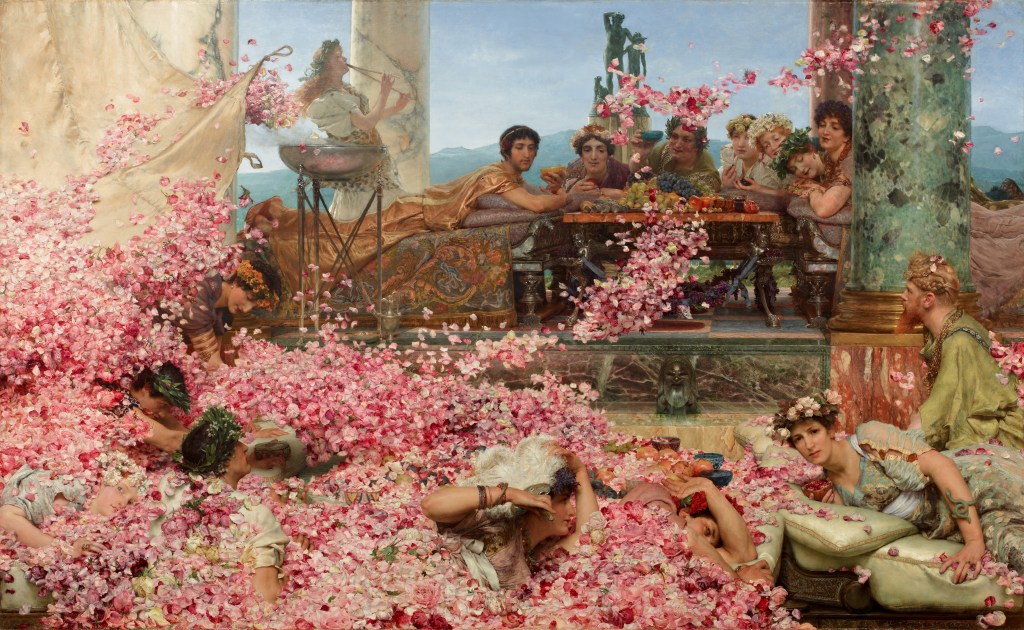
Alma Tadema, de rozen van Heliogabalus, 1888, particuliere collectie.
De mensen op het schilderij ‘De rozen van Heliogabalus’ lijken zich kostelijk te vermaken. Vanaf een podium en aanliggend aan een banket (gebruikelijk onder patriciërs), slaat keizer Heliogabalus (die maar 18 jaar oud werd) gade wat zich onder hem ontvouwt. Op de achtergrond bespeelt iemand een dubbel blaasinstrument, welke melodie zeker zal hebben bijgedragen aan de algehele sfeer, net als het zacht klaterende water dat uit de mond van een stenen mannenkop (ook wel ‘mascaron’ genoemd) een bassin instroomt. De bries zorgt voor voldoende verfrissing dankzij de open structuur van het bouwwerk waarin ze vertoeven. Het meest opvallend zijn natuurlijk de roze rozenblaadjes die van alle kanten naar beneden worden gestort uit een verlaagd plafond, en die een groot deel van de compositie innemen. De warme kleur gaat trouwens een mooi contrast aan met de groene zuil (van malachiet waarschijnlijk) en de koele blauwe lucht.
Wie iets beter kijkt, ziet dat uit de bloemenzee een aantal hoofden steken en her en daar een arm. Hun met bloemen en planten bekroonde kapsels zijn met detail geschilderd. De laurier, lelietjes-van-Dale en anjers in hun kransen moeten met hun lokale geuren het etentje nog verder hebben opgeluisterd. De brandende wierookschaal links van het podium waar zichtbare parfumwolken uit opstijgen maakt de geursymfonie compleet.
Maar ondanks al deze pracht en sensueel genot, wordt al snel duidelijk dat er iets niet pluis is aan dit tafereel. De (enige) blonde – nog onbedekte – man rechts op de voorgrond heft zijn lichaam op om eens goed te kijken naar de mensen die tegenover hem hun armen uitstrekken en die langzaam uit het zicht lijken te verdwijnen. Er spreekt alertheid uit zijn houding. Voorvoelt hij hun (en zijn eigen) lot? Wat er staat te gebeuren is namelijk helemaal niet zo feestelijk. De sadistische keizer trakteert zijn gasten willens en wetens op zo’n grote lading aan rozen dat de dikke laag geen zuurstof meer toe zal laten. De genodigden zullen stikken. Dit geeft het woord ‘verbloemen’ (dat van origine betekende dat een kwalijke lucht door een welriekende werd verhuld) een wel heel andere betekenis, al kan ook geur je natuurlijk ook de adem benemen.
Aromatisch aanliggen
Of deze lugubere gebeurtenis echt heeft plaatsgevonden, is niet zeker. Er was vaak sprake van negatieve propaganda door opvolgers of vijanden van hooggeplaatste figuren. De Amerikaanse Italië-expert Wiliam Roscoe Thayer (1859-1923) tekende in zijn Historia Augusta op dat ook keizer Nero zo ooit zijn gasten verraste. Heel waarschijnlijk is dat volgens oudheidkundige Mark Milligan niet, want Nero had veel politieke tegenstanders die hem op die manier in een kwaad daglicht wilden stellen. Maar dat Nero de mogelijkheid had om zijn bezoekers te overladen met bloemen, staat vast. Hij beschikte in zijn Domus Aurea (die vlak bij het Collosseum staat) over een wonderbaarlijk plafond. De Romeinse biograaf Seutononius gaf een beschrijving van zijn opzienbarende ‘gulden villa’:
Delen van het huis waren bedekt met goud en bezaaid met edelstenen en parelmoer. Alle eetkamers hadden plafonds van bewerkt ivoor, waarvan de panelen naar achteren konden schuiven en een regen van bloemen of parfum uit verborgen sproeiers op gasten konden doen vallen. De grote eetzaal was cirkelvormig en het dak draaide dag en nacht langzaam rond, op het ritme van de hemelen.
Zo’n plafond was redelijk uniek, maar het gebruik maken van aroma’s en parfums tijdens banketten was dat allerminst. Anders dan nu werd er namelijk volop aandacht geschonken aan zowel de ‘interne’ als de ‘externe’ neus, dus er moest continu wat te ruiken zijn. Er werden zelfs parfums gegeten om zich van binnen en buiten doordrongen te voelen door de heerlijkste aroma’s. De bittere smaak nam men voor lief. De gasten die binnenkwamen kregen allereerst parfum aangeboden om hun handen mee in te wrijven en zich zo welkom te voelen (iets wat in Turkije nog steeds op grote schaal gebeurt). Op de grond lagen bloemen en kruiden die bij het kneuzen door de voeten van de gasten hun aroma’s prijsgaven. Munt en saffraan werden gebruikt om tafels en muren mee in te wrijven. En tussen alle gangen werd er weer met parfums rondgegaan. Als het bovendien koud was, dan werden er aromatische harsen en kruiden in de open haard gegooid (iets wat ook in Nederland gebeurde in grachtenpanden in de zeventiende en achttiende eeuw).
Om elkaar te overtroeven, nam het aanbieden van parfums soms absurde en spectaculaire vormen aan. De Griekse schrijver Athenaeus van Naucratis (eind tweede – begin derde eeuw )die enige tijd in Rome woonde, beschreef een methode die zeer tot de verbeelding spreekt:
For he did not use no alabaster box
From which t’ anoint himself; for this is but
An ordinary, and quite old-fashioned thing.
But he let loose four doves all dipp’d in unguents,
Not of one kind, but each in a different sort;
And then they flew around, and hovering o’er us,
Besprinkled all our clothes and tablecloths
Nu zou het onder dierenmishandeling vallen om duiven te begeuren (om ze op te dienen dan weer niet ironisch genoeg), maar het is niet moeilijk om voor te stellen hoe hun vlucht een waar spektakel voor oog en neus moet hebben opgeleverd en hoe elke kubieke centimeter langzaam transformeerde in een kaleidoscopisch parfum dat overal net anders moet zijn geweest. De dichter Martialis (ca. 40-ca. 103) die ook het een en ander had meegemaakt op dit gebied, vond de aromatische eetfeestjes echter zo exorbitant, dat hij er – op magistrale wijze – de spot mee dreef:
“Faith ! Your essence was excelling,
But you gave us nought to eat ;
Nothing tasting, sweetly smelling,
Is, Fabullus, scarce a treat.
Let me see a fowl unjointed
When your table next is spread ;
Who not feeds, but is anointed,
Lives like nothing but the dead.”
Rozen in Rome
Tadema schilderde de duizenden rozenblaadjes in het schilderij naar het leven. Ze werden in de winter van 1887-1888 wekelijks per trein aan Tadema’s atelier geleverd in Londen en dat vier maanden lang. De rozen moesten helemaal uit de Côte d’Azur komen en naar Londen worden overgebracht, omdat het koude klimaat in Engeland niet geschikt was voor deze bloemen in dit seizoen. Hij zal de blaadjes zelf van de rozenkoppen hebben getrokken, want losgemaakt zouden ze het niet hebben gered. Maanden na dato vond de schilder ze nog in zijn studio. En gezien gedroogde blaadjes nog steeds een sterk parfum afgeven (denk aan potpourri), zal ook de geur er nog lang hebben gesluimerd.
Deze anekdotische informatie is niet alleen grappig, maar essentieel. Het betekent namelijk dat Tadema zich in exact dezelfde aromatisch geladen atmosfeer bevond als de dinergasten die hij schilderde. Dat moet wel van invloed zijn geweest op de minutieuze wijze waarop hij de blaadjes stuk voor stuk vastlegde, maar ook de sfeer die hij wist over te dragen.
Toen ik 2012 in de winter in Rome op het Kunsthistorisch Nederlands Instituut Rome (KNIR) verbleef voor onderzoek (naar historische geuren uiteraard), liep ik nietsvermoedend een tentoonstelling binnen met het werk van Tadema. Ik was helemaal niet van plan te gaan en kwam er slechts toevallig voorbij onderweg naar Piazza Navona. Ook ‘ons’ schilderij was aanwezig. En wat me daar overkwam, staat me nog helder voor de geest. Het was spectaculair. De curatoren hadden namelijk besloten om de geur van rozen door de galerie te verspreiden. Ondanks al mijn eerdere ervaringen met museaal geurgebruik was ik verbluft. Oog in oog met het reusachtige doek leek het net alsof de picturale ruimte van het schilderij niet langer begrensd was door een geverfd oppervlakte en een lijst. Die ruimte zette zich – dankzij de geur – voort in de ruimte om mij heen alsof de voorstelling zichzelf projecteerde. De kleur roze was niet langer een pigment maar een gloedvolle stralende wolk die zich naar mij uitstrekte. De voorstelling was uit zijn eigen domein getreden en bevond zich nu overal om mij heen. Destijds wist ik niet dat ook Tadema dit effect ondergaan moet hebben en dat ik niet alleen het banket maar ook zijn atelier rook. In deze wetenschap krijgt zelfs de herinnering aan die ervaring een extra gloed.
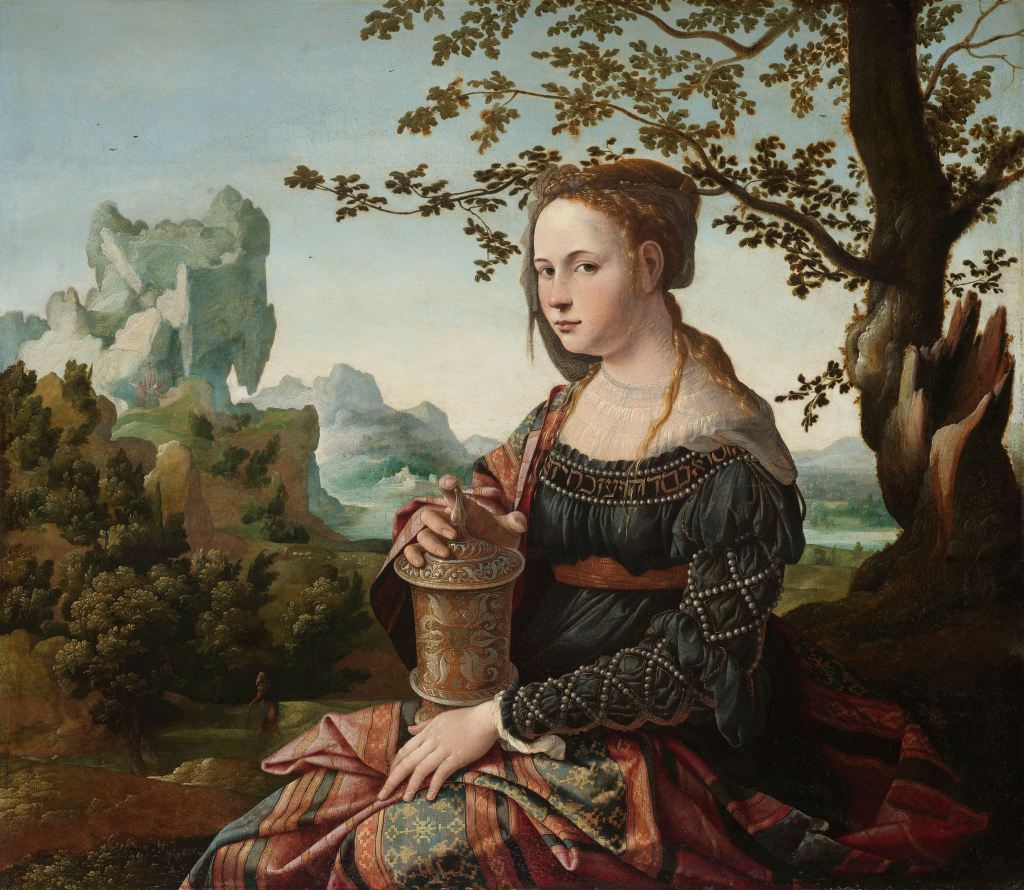
Jan van Scorel, Maria Magdalena, ca. 1530, collectie Rijksmuseum
Door Dr. Caro Verbeek, geur- en kunsthistoricus.
Zien we op een afbeelding een rijk uitgedoste vrouw met weelderige lokken – die soms zelfs tot haar voeten komen – dan is de kans groot dat we met Maria Magdalena te maken hebben. Is in dezelfde voorstelling een kruik of zalfpot afgebeeld, dan is er geen twijfel meer mogelijk over de identiteit van deze Bijbelse figuur.
Hoewel haar persoon wordt omgeven door mythes en valse aannames, zijn een paar dingen over Maria Magdalena zeker. Uit het Nieuwe Testament blijkt bijvoorbeeld dat zij de enige vrouw was uit het vaste gevolg van Jezus. Ze zou zelfs een van zijn lievelingen zijn geweest met wie hij zo intiem was, dat hij haar op de mond kuste. Omdat ze als ongetrouwde vrouw zonder begeleiding met een stel vrijgezelle mannen optrok, werd ze in de geschiedenis vaak onterecht als een zondige en zelfs als prostituee voorgesteld. Pas in 1969 werd haar naam door de paus in ere hersteld. Het is waarschijnlijker dat Maria een weduwe was: in die hoedanigheid was het geen schande om ongehuwd met mannen op te trekken.
Wat ook zeker is, is dat Maria Magdalena bijzonder welgesteld was. Dit is in de schilderkunstige traditie onder andere af te leiden uit haar kleding. Haar uitdossing en haardracht zijn vaak aangepast aan de tijd waarin de kunstenaar leefde, zoals in het geval van Jan van Scorels exemplaar uit het begin van de zestiende eeuw. Doorzichtige voiles en borduursels met kralen, geven de heilige een eigentijds en modieus uiterlijk, zodat de toeschouwer zich direct met haar verbonden voelde. Je zou haar immers zo op straat kunnen tegenkomen. Als je geluk had tenminste.
Er is nog een belangrijkere aanwijzing voor Maria’s rijkdom. En dat is de al even genoemde zalfpot. Geen wonder dat schilders deze vaak zo’n prominente plek geven en voorzien van de mooiste decoraties. Toch gaat het niet om de buitenkant van dit voorwerp, maar om dat wat het omvat: een olie. En niet zomaar een olie, maar wel de duurste geurstof die op dat moment – dus zo’n tweeduizend jaar geleden – voorhanden was.
Deze in de vergetelheid geraakte geurstof speelt de hoofdrol in ‘de zalving te Bethanië’: een verhaal dat door meerdere evangelisten is opgetekend. De meest intieme vertelling komt van Johannes. Na de opwekking van Lazarus (ook een bijzonder geurige aangelegenheid, Lazarus was immers al een tijdje dood…), wordt een groot feest gegeven ter ere van Jezus en het wonder dat net heeft plaatsgevonden. Natuurlijk is Jezus van de partij. In het huis van Lazarus wordt hij opgewacht door Maria, waarna zich een scène ontvouwt die niet had misstaan in een Hollywood-film:
“En toen nam Maria een kruikje kostbare zuivere nardusolie, zalfde de voeten van Jezus, en droogde ze met haar haar: de geur van nardus trok door het hele huis.”
De betekenis van deze zin zal bijna iedere hedendaagse lezer ontgaan en dat komt doordat we niet meer weten wat de waarde en rol was van deze geurstof. Nardus was een heel bijzondere plantaardige welriekende stof die alleen was voorbehouden aan personen met de allerhoogste status, zoals hogepriesters, farao’s, goden en de god uit het Christelijke monotheïsme. Het was dan ook niet makkelijk om aan dit goedje – dat nu bekend staat onder de wetenschappelijke naam Nardostachys jatamansi – te komen dat helemaal uit de Himalaya afkomstig was. Het had Maria dan ook een heel jaarinkomen gekost (zo’n dertig denari) om er een kruikje van te bemachtigen. Dat ze het gebruikt voor Jezus’ zegt niet alleen iets over haar financiële situatie, maar ook iets over haar relatie met de ‘gezalfde’ (de letterlijke betekenis van ‘Christus’). Ze erkent hem met die daad als een wereldlijk en geestelijk leider en iedereen die aanwezig was en het geringste vleugje van die geur waarnam, moet dat begrepen hebben. ‘De geur trok door het hele huis’, staat er niet voor niets.
Maar er is nog iets aan de hand. Normaal gesproken worden alleen de voeten van een dode gezalfd. Dit wijst erop dat Maria de enige is – naast Jezus – die op dat moment weet dat hij binnenkort zal gaan sterven. De geur is haar laatste eerbetoon aan een persoon die haar dierbaar is.
De meester van Mansi
Hoewel kunstenaars meestal niet de nadruk leggen op de inhoud van de kruik, doet de zogenaamde ‘Meester van Mansi Magdalena’ – een Nederlandse schilder uit de Renaissance- dat wel. Zijn Maria is frontaal afgebeeld en staart de toeschouwer uitdagend aan. Ze heeft haar zalfpot geopend en nodigt je uit om de goddelijke geur die erin zit te ruiken en om direct deel te nemen aan de gebeurtenis door er niet alleen naar te kijken, maar die zelfs op te snuiven. Maar waar mensen zich deze geur in de tijd dat dit schilderij gemaakt werd vast nog wel konden voorstellen (mits men de geur eerder had waargenomen natuurlijk), ruiken wij alleen maar olieverf. Wij zijn het daarbij niet gewend om met een olfactorische blik te kijken. Wie de pose visueel benadert, ziet dus alleen maar een lege pot terwijl deze in olfactorisch opzicht onmetelijk rijk gevuld is.
Meester van Mansi Magdalena (actief tussen 1510-1525), Maria Magdalena, circa 1525, collectie Gemäldegalerie, Berlijn
Overgeromantiseerde geur?
Een recentere vermelding van nardus, zien we in de vermaarde roman The Picture of Dorian Gray (1890) van Oscar Wilde (1854-1900). Het boek – dat hij baseerde op het iets oudere Tegen de Keer (1884) van J.-K. Huysmans – werd als schandelijk en immoreel ontvangen.
Hoofdpersoon Gray – een narcist die nooit ouder lijkt te worden, omdat al zijn slechte daden en leeftijd zich alleen aftekenen in een portret van hem – was wars van intellectuele speculatie. Volgens hem zouden de werkelijke spirituele mysteriën van het leven schuilgaan achter de zintuiglijke waarneming en daarin niet onderdoen voor de ziel zelve. En daarom begon hij zich te bedrijven in de kunst van het mengen van parfums, iets waarvan ook de hoofdpersoon in Huysmans’ roman zich meester maakt. Gray gebruikte geuren (net als Wagner overigens) om bepaalde sferen en geestestoestanden te creëren:
He saw that there was no mood of the mind that had not its counterpart in the sensuous life, and set himself to discover their true relations, wondering what there was in frankincense that made one mystical, and in ambergris that stirred one’s passions […]; and seeking often to elaborate a real psychology of perfumes, and to estimate the several influences of sweet-smelling roots and scented, pollen-laden flowers […]; of spikenard, that sickens; of hovenia, that makes men mad; and of aloes, that are said to be able to expel melancholy from the soul.
Wilde was er – net als zijn tijdgenoten – van overtuigd dat geurstoffen onlosmakelijk verbonden waren aan een specifiek effect en dat nagenoeg iedereen dit zo ervaarde, zonder daarbij individuele voorkeuren in ogenschouw te nemen. In de negentiende eeuw werd er dan ook gedacht dat esthetiek bestond bij gratie van collectieve, universele waardering. Nardus noemt hij opvallend genoeg ‘misselijkmakend’. Dit nam hij direct over van Huysmans, die schreef over hoe de decadente op genot beluste Des Esseintes een parfumconcert voor zichzelf voortijdig afbrak:
He worked with amber and with Tonkin musk, marvelously powerful ; with patchouli, the most poignant of vegetable perfumes [..]. Try what he would, the eighteenth century obsessed him […]; Furious, he rose and to rid himself of the obsession, with all his strength he inhaled that pure essence of spikenard, so dear to Orientals and so repulsive to Europeans because of its pronounced odor of valerian. He was stunned by the violence of the shock. As though pounded by hammer strokes […].
Des Esseintes was geërgerd door zijn eigen obsessie met de geschiedenis, in dit geval van de achttiende eeuw. Het overmande hem en hij werd er te veel door afgeleid. Om in een keer verlost te zijn van zijn sentimentele door geuren gefaciliteerde reis, besluit hij daarom even aan nardus te ruiken. Als door een klap met een hamer komt hij bij zinnen. Er staat nog iets interessants, namelijk dat nardus geliefd is bij mensen uit ‘het oosten’ en gehaat wordt door Europeanen.
Door lezingen en rondleidingen heb ik wat ervaring kunnen opdoen met betrekking tot de reacties op nardus en die lopen zeer uiteen. Ik vraag het publiek vaak hun hand op te steken om zo een schatting te kunnen maken bij welk percentage het bevalt of juist niet. En dat is binnen een Europees publiek altijd – zonder uitzondering – ongeveer de helft. Het is nooit onderzocht, maar ik vermoed dat er net zoiets aan de hand is als bij koriander dat de een naar zeep of metaal vindt smaken en dat de ander als heerlijk kruidig ervaart. Dit verschil kent een genetische oorsprong. De ene groep vindt nardus naar zweetvoeten, verderf en kaas ruiken en de ander naar aarde en eucalyptus. Ik behoor gelukkig tot die laatste groep. Maar. Het frappante feit wil wel, dat wanneer ik een kaaswinkel binnenloop, een zweem nardus meen waar te nemen op de achtergrond.
Ivan Albright, The Picture of Dorian Gray, 1943/1944, collectie the Art Institute of Chicago. Dit schilderij werd speciaal gemaakt voor de verfilming van het boek van Oscar Wilde in 1945.
Nota bene: in de schilderkunstige traditie worden Maria Magdalena en Maria van Betthanië vaak met elkaar vereenzelvigd
When I worked for the European olfactory heritage project Odeuropa, I came up with the idea to create a scent wheel based on olfactory iconographies (paintings with narratives that include smell, such as the three Magi with their frankincense and myrrh, or Mary of Magdalen with her jar of spikenard). I was inspired by a feature on Europeana in which one could select a colour, which would lead the user to paintings that contain that very same colour. The surprise element was what made this so compelling to use. And I wondered: what if a smell could do the same? A painting with Napoleon, who amply used eau de Cologne, could then be linked to a bathing scene by Bonnard in which a woman uses the same scent. A spicy scent could lead one from a scene with a merchant to a Bestiary in which a panther’s breath is described as such. I elaborated on the wheel a bit and added some more categories that include Impressionist and classic modern art. It is not encyclopedic but a good starting point to train your olfactory gaze or include smells in your museum practice.
How to read the wheel
The inner ring contains scent categories or families such as resins, the one in the middle specific scents (such as frankincense and myrrh), and the outer ring specific themes (for example the adoration of the magi) or even specific paintings containing that smell as part of the narrative or as a depicted element. Every colour block unites art works that visually have very little in common, but that contain the same (imaginary) smell.
Concept Caro Verbeek
Nose-first art historical scent wheel. Concept: Caro Verbeek/ Odeuropa, based on research by Caro Verbeek and Lizzie Marx and with the help of Sofia Ehrich. If you would like to use it, use this caption please:
Or read our olfactory museology paper Verbeek, C., Leemans, I., Fleming, B. (2022), “How can scents enhance the impact of guided museum tours? towards an impact approach for olfactory museology”, Senses & Society, here: https://doi.org/10.1080/17458927.2022.2142012



















 Futurist Scents